
RevolutionNewton1776
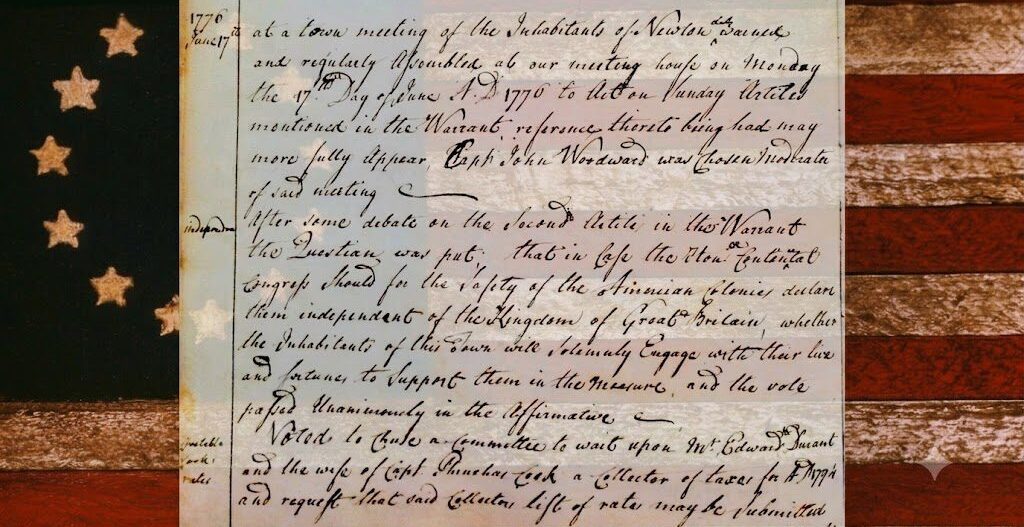
Notes from Newton's 1776 Town Meeting (flag background is made with Google Gemini). Courtesy of Historic Newton
It may surprise you to learn that Newtonians love expressing their opinions. And it seems that’s always been the case.
In June of 1776, Newton’s Town Meeting—a system of direct democracy that still exists in towns today but back then only included white land-owning men—approved its own declaration of support for independence from Britain.
It wasn’t exactly spontaneous. A few weeks prior, the Massachusetts House of Representatives had passed a resolution requiring every town to debate and vote (via representatives to the Provincial Congress) on whether they support independence.
By then, the Town of Newton was more than ready to tell Britain where to stick its stamps. Literally. Newton’s 1765 Town Meeting had instructed its state representative, Judge Abraham Fuller, to officially record the town’s opposition to the Stamp Act imposed by Britain’s parliament that year.
In 1767, after Parliament passed the Townshend Act restricting trade to and from the colonies, Newton’s Town Meeting joined the efforts of several other communities in pledging to boycott British imports and shift to trade between communities and colonies.
It was the original “Shop Local” movement. And eventually British soldiers were run out of town because just the sight of them was becoming rage fuel.
“Already they were sort of making their voices heard, directly, leading up to the revolution,” Historic Newton Director of Education Allison Pagliaro said. “There was what was called a Committee of Correspondence. They appointed influential men who led these town meetings, and under that, they boycotted imported goods, boycotted the East India Trading Company.”
One of those men leading Town Meeting in those days was Edward Durant III, an outspoken advocate for independence whose family owned the Durant-Kenrick Home now managed by Historic Newton. His son, Thomas, fought at the Battle of Lexington and Concord in 1775.
Newton was no stranger to rabble-rousing for a cause. In 1773, Newtonians Michael Jackson and Obadiah Curtis participated in the 1773 Boston Tea Party.
So, by 1776, Newtonians were eager to sever ties with the Crown and start a new course as part of a new independent state (the idea at the time was that the colonies would be separate states in a federation with other independent states, not a new unified nation with a centralized government; that latter part came with the formation of the Federalist Papers and later the Constitution).
When Town Meeting voters met to give Newton’s opinion on independence, they did so with gusto.
“They were definitely feeling it,” Pagliaro said.
The post-Town Meeting statement reads:
“…in case the Hon. Continental Congress should for the safety of the American Colonies declare them independent of the Kingdom of Great Britain, whether the inhabitants of this town will solemnly engage with their lives and fortunes to support them in the measure, and the vote passed unanimously in the affirmative.”
Was there a loyalist presence in Newton?
“Newton only had three loyalists on record,” Pagliaro said. “Two of them were kicked out of town for being loyalists, and the third publicly renounced his belief, but I have reason to believe he did it to placate them.”
Newton has no direct link to the signing of the Declaration of Independence, but Roger Sherman, a delegate from Connecticut, was born in Newton.
To find out more about Newton’s robust history, check out the new exhibit at the Jackson Homestead.
Share This Story On:
DONATE TO SUPPORT LOCAL NEWS
Your tax-deductible gift to the Newton Beacon keeps our community connected and its residents informed.
Get story alerts twice a week:
Related Posts




Upcoming Events