
edcenter012723
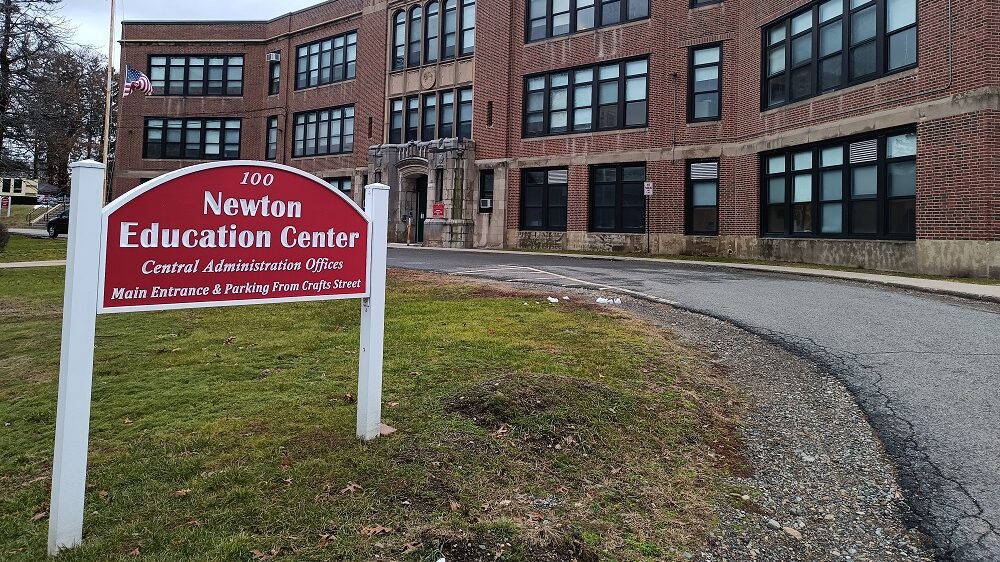
The Newton Education Center. Photo by Dan Atkinson
Newton school committee members met in person on Sept. 28 to discuss how the district’s new math curriculum is unfolding, to review the status of last year’s budget and to hear updates on facilities costs and upgrades continuing into the new school year.
The committee unanimously approved updates to the student rights and responsibilities handbook, which included a ban on the use of artificial intelligence unless given teacher permission and a strict ban on personal devices in school for K-8 students and in class for high school students.
The district’s business and finance office was recently awarded the Meritorious Budget Award by the Association of School Business Officials International (ASBO) in recognition of its transparent and organized budget presentation. Superintendent Anna Nolin said the award has only been given to four other districts in the state previously.
Awino Odhiambo, a financial analyst for the district, was also recognized by ASBO with an Emerging Scholars Award. Between grants and the existing budget, the district managed more than $360 million in the last year.
During public comment, which was extended 10 minutes longer than the usual 30-minute window, seven parents spoke against the recent hiring of a middle school history teacher who wrote her college thesis about the response to the pro-Palestinian campus protests at her alma mater. Four parents spoke in the teacher’s favor.
Math Pathways rollout
The school committee heard its first update on the rollout of the new Math Pathways program, which was announced last spring. Gina McCarthy, assistant superintendent for teaching and learning, and Jennifer Shore, director of mathematics, shared that 70% of 59 middle school students enrolled in a “summer bridge” math program saw their test scores improve. Seventy-eight percent of families rated themselves as satisfied or very satisfied with the program.
The new middle school math curriculum plan was initially met with some criticism, especially from parents at Bigelow Middle School, where only one student originally scored high enough to be placed into a new accelerated eighth grade math class. Other students have since been placed in the class, according to Nolin.
McCarthy and Shore told the committee that newly hired middle school math specialists have been supporting existing math teachers as part of the program’s rollout. The district expects the Math 2 curriculum to be in effect by March 2027 and all sections of Math 3 to be rolled out in the high schools by December 2027.
Ben Schlesinger of Ward 5 asked how district administrators are managing concerns from some teachers about the speed of these curriculum changes.
“Teachers are saying ‘Hey, our foot is on the gas because we got to get through a year-plus of curriculum,’” he said. “How anxious are we that we’re asking too much of our students and our teachers?”
McCarthy said she has not been to the schools to speak to teachers about the rollout but that she is confident about the program’s success based on initial test scores of seventh grade students.
“I would say this is going to be really hard and we’re going to pull it off,” she said.
Budget and facilities update
Chief Financial and Administrative Officer Liam Hurley gave the school committee an extended presentation on the status of the district’s budget coming out of the 2025-2026 school year. Taking into account a previous deficit of $620,000 and all expenditures, including teacher salaries and building utilities, the district was left with a balance of $22.54 plus a $1.4 million in “circuit breaker” funds that carry over into the following year.
Hurley said utility costs were higher than expected due to a colder than expected winter, and maintenance costs were $438,000 over budget across the district. Newton North High School is consistently the district’s most expensive building to operate, costing more than $1 million in utilities each year. He added that he has identified ways to save the district money if budget constraints require it.
“We call it an essential purchasing and hiring freeze—it can make a difference, it’s not something we want to do, but it does create results for us,” he said.
In addition to the budget discussion, Hurley highlighted the district’s strides in updating old school buildings with air conditioning and the recent opening of the new Horace Mann Elementary School building. The new Countryside and Franklin elementary school buildings will follow later this school year.
The district’s current school bus contract expires this year, opening up an opportunity for the district to receive bids from busing companies, including those that run electric school buses.
Arianna Proia of Ward 1 asked Hurley how the bidding process works, in light of some community interest in switching to electric buses.
According to Hurley, there are not many companies in the electric school bus market, but the district is open to receiving their bids. He added that as one of the larger school districts outside of Boston, an electric busing company would need to be able to meet the size of Newton’s district, which currently runs 34 school buses.
Hurley said he is open to asking busing companies to provide five and 10-year bid plans for the district to compare before settling on its next contract in the upcoming year.
Share This Story On:
DONATE TO SUPPORT LOCAL NEWS
Your tax-deductible gift to the Newton Beacon keeps our community connected and its residents informed.
Get story alerts twice a week:
Related Posts




Upcoming Events