
fullerprofile
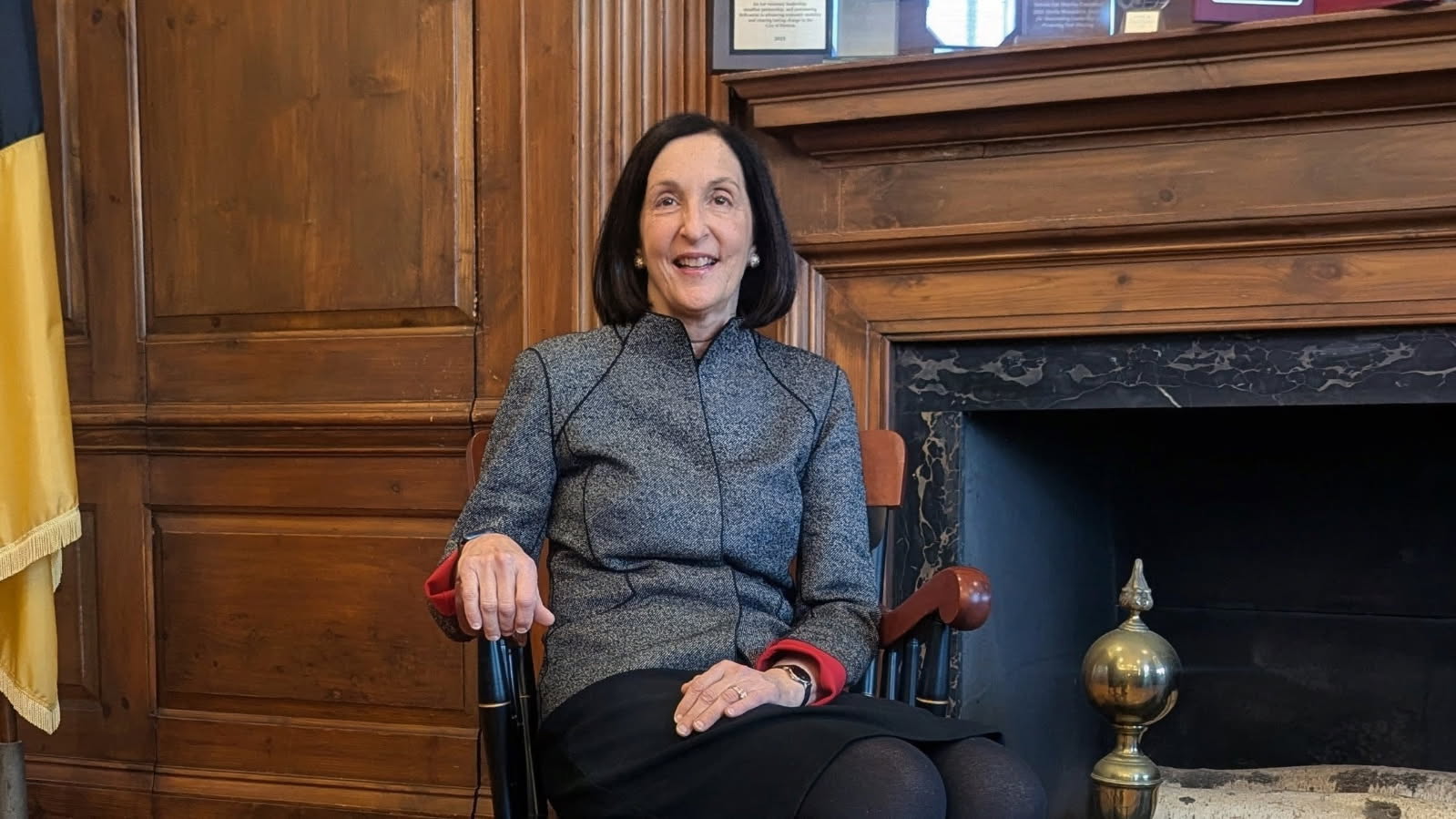
Mayor Ruthanne Fuller, December 2025. Photo by Bryan McGonigle
On a frozen December morning, Newton Mayor Ruthanne Fuller sat in the gymnasium of the new Cooper Center for Active Living with city officials, past elected leaders and countless others who had come to see a promise fulfilled.
Lt. Gov. Kim Driscoll, former mayor of Salem and a friend of Fuller’s, was speaking about the center being a “capstone” to Fuller’s legacy of building a better Newton for everyone.
“As we close the end of your term, what might be a final major project in office, this Cooper Center stands as a real lasting legacy and one that will serve the community for decades,” Driscoll said as Fuller sat and took it all in.
A lot had happened in the nearly eight years since Fuller took office. There was a pandemic. An inflation crisis. A teacher strike. A village center zoning battle.
But through those storms, Fuller’s administration pushed onward, often at odds with residents and businesses and other elected officials, with an agenda that is transforming the city, even if now, in hindsight, she would do some things differently.
From the Motor City to the Garden City
Fuller was born Ruthanne Schwartz in December of 1957 and raised in Detroit. Her family moved to a Michigan suburb when she was in high school.
At 13, she met a boy named Joe Fuller who would one day give her his devotion and his last name. But they started out as good friends.
“His dad took a job at General Motors as the vice president of human resources, so Joe ended up transferring into the same high school as me,” she recalled fondly as she sat down at the conference table in her office.
The duo stayed close in college—he went to Harvard, she went to Brown University in Rhode Island—and started dating during their freshman year.
She went on to earn her MBA at Harvard as well, and then the Michigan transplants got married and looked for a place to raise a family—they had three young kids—near Boston in the early 1990s. That’s when they found Newton, which Fuller said stood out for its “fabulous people, fabulous neighborhoods.”
Making their new home in the village of Chestnut Hill, Joe founded a management consulting firm while she built a career in strategic planning.
What does that entail?
“After Harvard Business School, I went to a major consulting firm and was in their strategic planning division,” Fuller said. “What that means is, for large corporations, important major decisions about lines of businesses that they should pursue—Should they enter a new market? Should they expand and how so?—big picture stuff.”
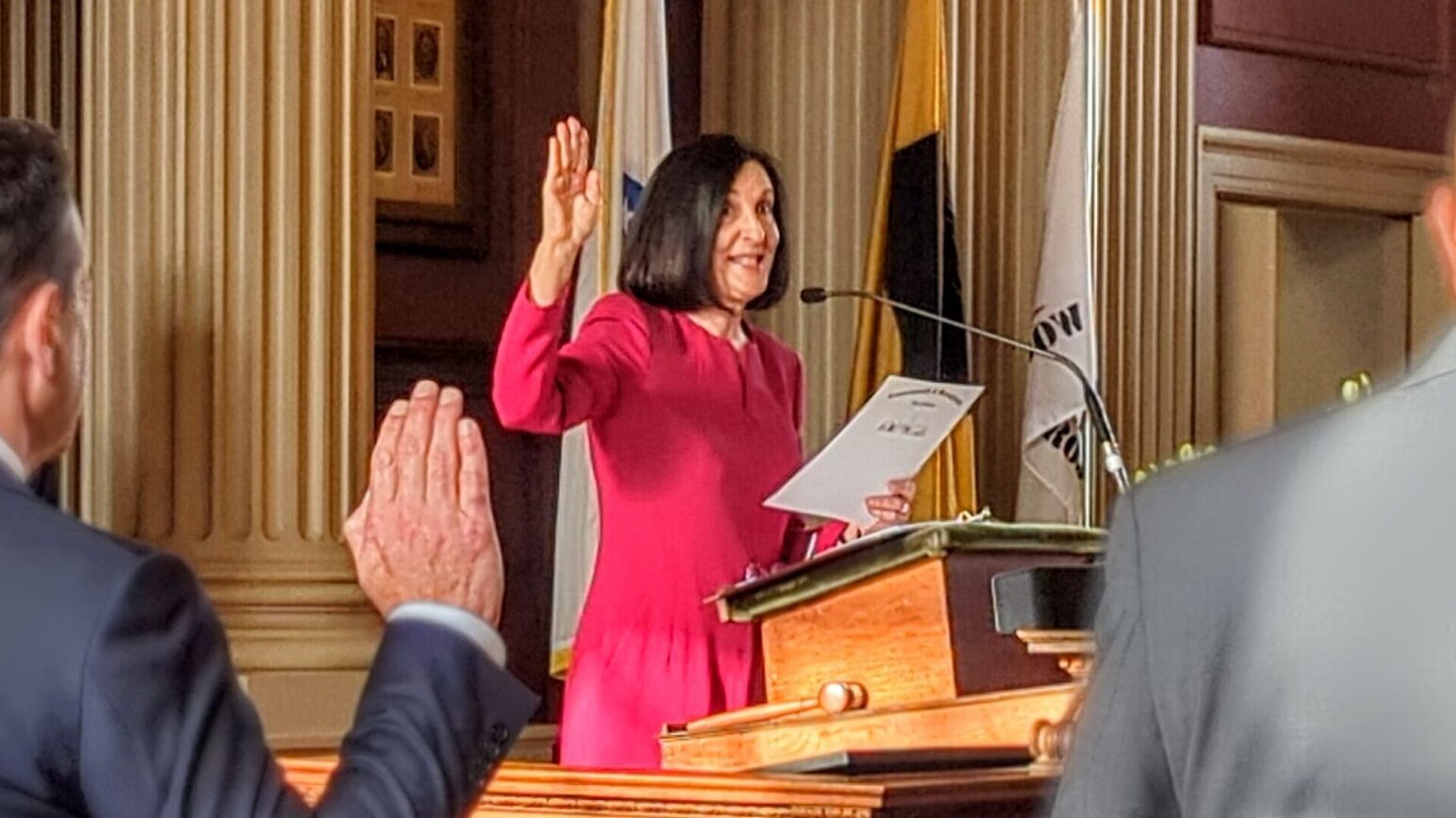
Newton Mayor Ruthanne Fuller swears in members of the City Council and School Committee on Monday, Jan. 1, 2024. Photo by Bryan McGonigle
Diving in
Fuller got involved in helping her community plan things, too. She joined the Chestnut Hill Association and eventually became its president.
Fuller put her financial and planning acumen to work and served on a blue ribbon commission on the city’s revenues, formed by then-Mayor David Cohen in 2006. She was also vice chair of the Citizen Advisory Group that Cohen and then-Board of Aldermen President Lisle Baker established in 2008, examining the city’s finances in their entirety.
“Between being part of the neighborhood association and then looking closely at the financial situation of the city, I dove in and began to meet more and more people in all walks of life across the entire city, and I became more concerned and excited about Newton,” she said.
Fuller had never run for office before. But with a taste of community work and a passion for problem-solving, she decided to take another deep dive, this time with a run for a Board of Aldermen spot held then by Vern Vance, who opted not to run for reelection in 2009 and encouraged her to run for his seat representing Ward 7.
“When Vern Vance chose not to run for reelection, he reached out to me and encouraged me to consider running for what was then the Board of Alderman,” Fuller said.
At the time, America was grappling with the Great Recession. Banks weren’t lending like they used to. Unemployment was stubbornly hovering around 10 percent. Cities and towns, like families across Newton and the nation, were in crisis trying to make ends meet. What would possess someone to enter the political arena packed with that kind of chaos?
“This is such a fabulous community, with great people, and I became very passionate about the issues we were facing, and hoped I could make a positive difference,” Fuller said.
Newton has maintained a AAA bond rating for decades, Fuller pointed out, which gave her confidence in the city’s ability to weather the fiscal storm of the Great Recession as she and new Mayor Setti Warren took office on Jan. 1, 2010.
She also had mentors guiding her: Vance, who encouraged her to run for his seat, as well as the other Ward 7 aldermen, Sydra Schnipper and Lisle Baker, and Mayor Cohen.
“I learned a lot by watching Mayor Cohen,” Fuller said. “So, I would point to the four of them in particular.”
Baker, now the president emeritus of the City Council, modestly disputes his role in her rise and said he encouraged her to run for alderman because she was already well-versed in local government and finance.
“I’m honored that she thinks I was a mentor to her, but she had enormous capabilities and knew a lot when she came into the role,” Baker said. “So I’m not sure that I could say I taught her anything. I was just glad to have her there.”
Former State Rep. Ruth Balser said she noticed Fuller’s passion for problem-solving early on.
“When I think about Ruthanne Fuller’s years of public service, what first comes to mind is her outreach to me about 20 years ago, when, as a member of the Chestnut Hill Association, she expressed concerns about protecting the precious environmental gems in the neighborhood—namely, Hammond Pond and Houghton Garden and the woods along Hammond Pond Parkway,” Balser said.
Balser added that Fuller had a special skill when it came to explaining the complex financial hurdles the city was facing, especially the unfunded pension and health benefits liability that was growing out of control.
“Sounding the alarm on what wasn’t a sexy issue, something others ignored, was a top priority for her,” Balser said.
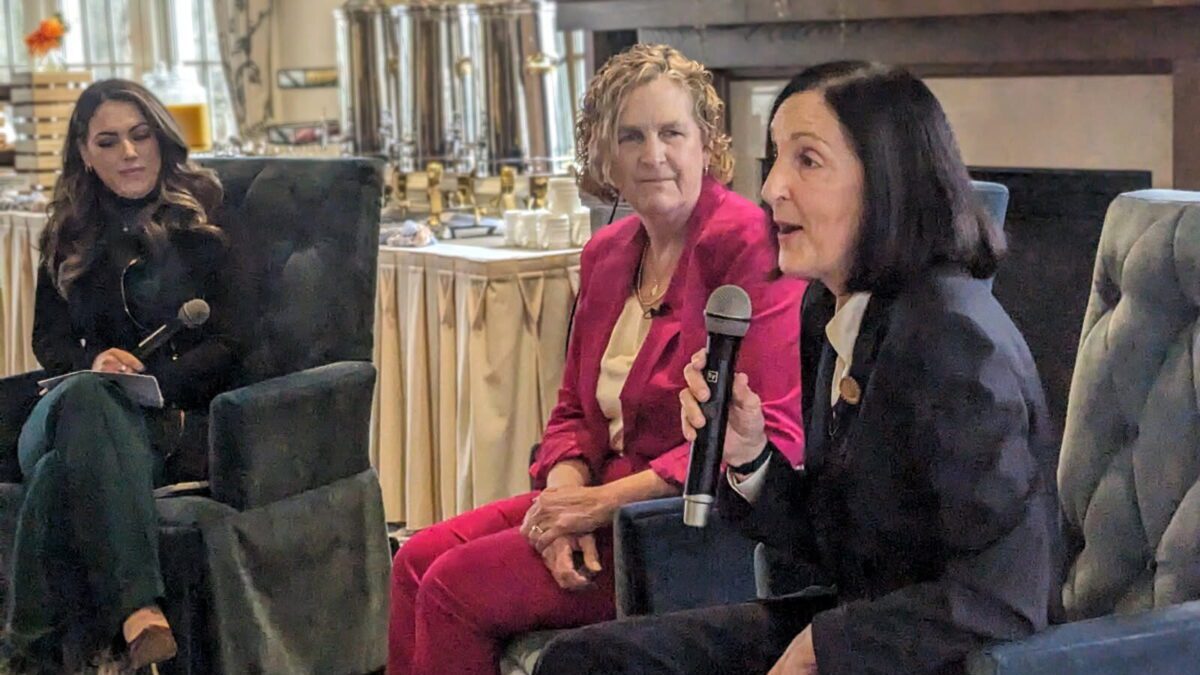
Mayor Ruthanne Fuller speaks at a Fireside Chat event with Needham Town Manager Kate Fitzpatrick, moderated by NBC10’s Priscilla Casper. Photo by Bryan McGonigle
Glass ceilings
In 2017, Mayor Warren decided to run for governor and announced he would not seek a third term as mayor. Fuller had been reelected to the Board of Aldermen—which became the City Council in 2016—several times, and she decided to go for the big job.
“I cared deeply about the entire breadth of the city and school system, and hoped by being in the mayor’s office, I could make even a bigger difference in leading the city and navigating our challenges, but coming from a position of strength,” she said. “I just love this city.”
Fuller launched a bid for mayor and faced former City Councilor Scott Lennon. The race was painted as one of class division, with Lennon hailing from working class Nonantum and Fuller from Chestnut Hill.
She’s quick to emphasize that she didn’t run to become the first woman mayor. She ran to be mayor, and it happened to be that no women had done it yet (Balser had run in 2009 but lost to Warren). But she acknowledges that gender matters.
“I know that when I walk into a room, all the science and data says the first thing people notice about you is either the color of your skin or your gender,” she said. ”Those are the first impressions, but what I have always operated on is trying to just do a really great job. And I hope that I’ve been a positive role model, certainly for little girls, but also for those little boys that they, too, can now imagine that a woman can be a mayor—that they’ve learned that and internalized it just as much as the little girls.”
Fuller’s 2017 run came at a time when the nation was fresh off a presidential election in which the first female major party nominee had just lost to a man who regularly insults women and had amassed several sexual assault accusations. And yet, that year also saw a Women’s March on Washington. Washington State saw more than 30 women mayors elected. The 2018 congressional midterms not only came with a wave of Democratic victories, it also ushered in a lot of new women into federal elected office.
And even in Newton’s local election, an ad run by Lennon that seemed to mock Fuller for not working while she raised young kids was seen by many as a sexist attack. Fuller pushes back on that criticism as well as the idea of a class divide.
“Scott Lennon was a terrific president of the city council and somebody who just loved Newton and a great human being,” Fuller said.
Fuller won in a tight race—her victory was by fewer than 350 votes—and Newton got its first woman at the helm of City Hall.
“I want to give some credit to Ruth Balser, who helped crack the glass ceiling eight years before me,” Fuller said.
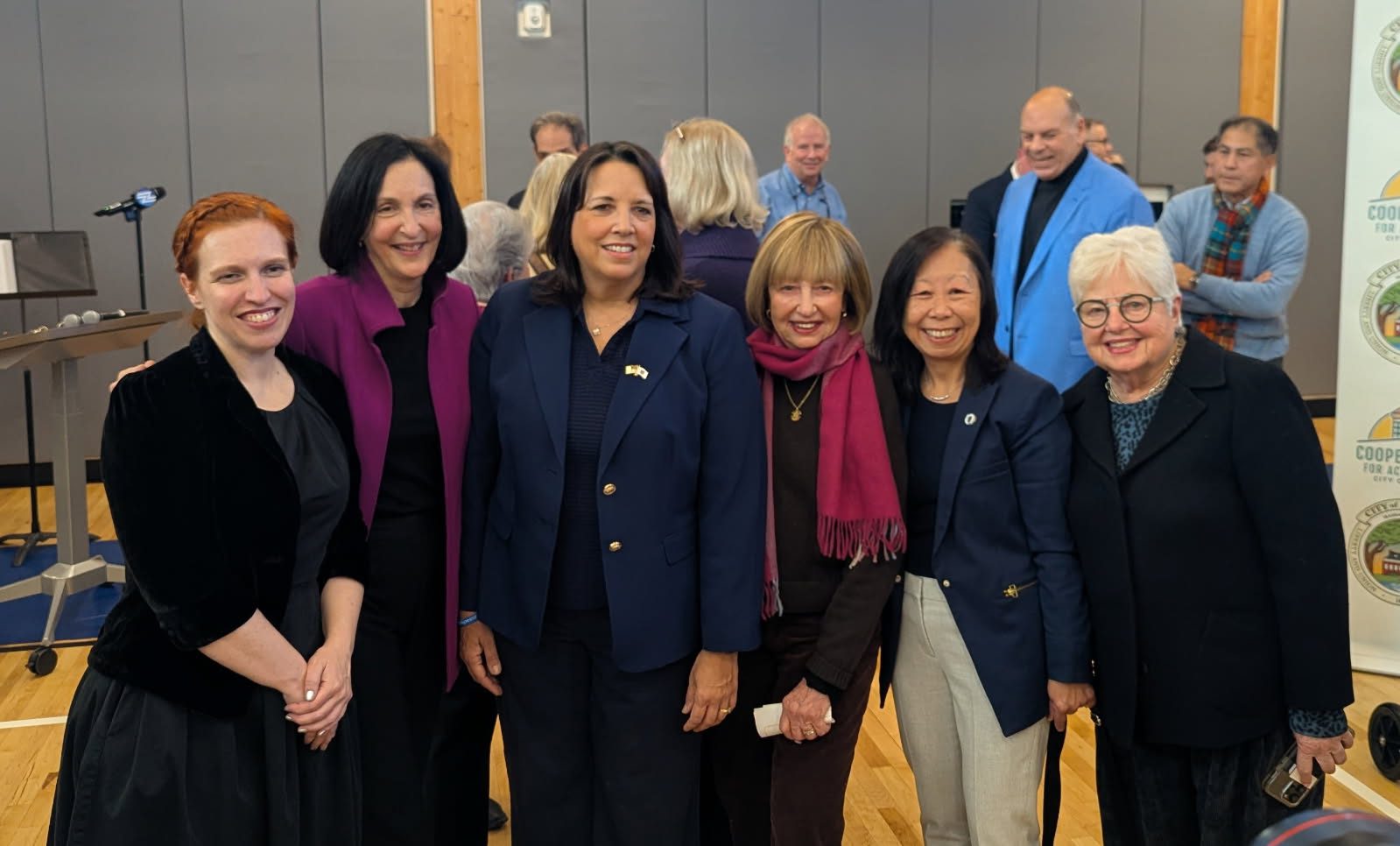
Left to right: Older Adult Services Director Mignonne Murray, Mayor Ruthanne Fuller, Lt. Gov. Kim Driscoll, State Sen. Cynthia Creem, State Rep. Amy Sangiolo and former State Rep. Kay Khan pose for photos at the Cooper Center for Active Living on Dec. 5, 2025. Photo by Bryan McGonigle
A plague arrives
Benjamin Franklin once said, “By failing to prepare, you are preparing to fail.”
Fuller has lived by a similar philosophy. Her private sector career was in strategic planning for businesses. Her time as alderman and city councilor was spent helping the city plan finances, development and more.
But nothing could prepare someone for what Fuller would face as mayor.
The COVID-19 pandemic that made its way across the globe crept into every community and upended public health, education, state and local budgets, fiscal planning and whole social systems. And how does a mayor build bridges in a community if no one can go near anyone else?
“I disappeared from home and essentially lived 24/7 at City Hall,” Fuller said. “I was leading our Health and Human Services team who were deeply worried about the number of Newtonians who were dying—especially in March, April, May—from an unknown virus with information that kept changing about what was safe and where.”
Leaders had to keep their communities going while so little was known, and people were so scared they were spraying bags of groceries with Lysol. Most businesses were closed for months, and the city was looking at an unprecedented revenue shortfall as a result. And the Centers for Disease Control was updating recommendations as the science was unfolding with new data about the new virus.
“We had to think about the 12,000-plus children and all the educators,” she said. “How do you teach and how do you care for the whole child, their mental health as well? How do you keep your police and firefighters and DPW workers and inspectors safe when, by default, their job involves interacting with one another and up close and impersonal? It was a really strange time.”
The city made it through the pandemic, and Fuller gives credit to the team she had in place leading each department. She also credits Boston’s then-mayor, Marty Walsh, for holding zoom calls with mayors on weekdays and weekends, and then-Gov. Charlie Baker for his administration’s work with cities and towns through the crisis.
“And we also were really helped by having [federal COVID-19 administrator] Ashish Jha and [CDC Director] Rochelle Walensky living here in Newton, who shared their personal cell phone numbers with me and I could call and get cutting-edge thinking,” she said.
Once the COVID-19 case counts leveled and dipped and the initial public health emergency was over and businesses and local governments opened back up and started operations, that’s when the next wave of pandemic problems arose.
There were debates nationally and in the state house about everything—when to roll back social-distancing restrictions, when to roll out vaccines and for which cohorts of people, how to get relief to people who were out of work for months—and locally, it was all about the schools.
One side wanted to keep teachers and kids and their vulnerable family members at home because the virus was spreading so rapidly and killing so many people. The other side wanted to get the kids back into schools because remote-learning was having negative effects including isolation and learning loss.
Making things even more complicated, both sides had legitimate concerns. And public opinion seemed to shift toward the middle of those two opposing perspectives in search of rational solutions in a seemingly chaotic “new normal.”
In Newton, schools were closed completely until late 2020, and then hybrid learning took over. It wasn’t until 18 months after the initial closings that schools were fully open. For a year and a half, kids went without socialization while parents protested and formed groups like Kids First Newton and pushed for the School Committee—on which the mayor has a seat—to end school closures so NPS families and staff could work on getting kids back on track.
Chris Brezski, outgoing School Committee chair, recently reflected on how angry parents were at that time and how the prolonged closure of the schools prompted him to run for office in the first place.
“I spent the better part of the year trying to get kids back in school and doing these petitions and organizing these doctors and doing all this stuff that the School Committee should have been doing, or the mayor should have been doing, or Health and Human Services should have been doing, or anyone should have been doing that wasn’t doing it,” Brezski said.
If she could do things differently, Fuller said, she would.
“In retrospect, as we’ve learned more about the disease and the repercussions of isolation, I think any of us would have rethought schools differently,” Fuller reflected. “At the time, given the shifting information, we certainly tried to make the best decisions given the current information.”
The voters, for all the anger and frustration over COVID-19 protocols and remote learning and general pandemic malaise, stood with her. In November 2021, Fuller won a second term in a race against then-City Councilor Amy Sangiolo, who now serves in the state legislature.
That margin of victory was wider than her first. Fuller won reelection with about 53 percent of the vote.
Insufficient funds
And then came the next aftershock of the COVID-19 quake: Inflation. As hundreds of millions of people around the world started driving again, demand sent gas prices into the stratosphere. As global supply chains remained in their pandemic mess, demand for goods soared and prices for everything from groceries to car parts began to soar as well. By summer 2022, inflation was over 9 percent, the highest since 1981.
Locally, that was devastating. Small businesses—which had been shuttered during the pandemic while big retailers were allowed to stay open—suffered because customers couldn’t buy as much with these new high prices. Consumers suffered because they couldn’t make their money go nearly as far as they could just months before. And cities and towns suffered because high costs and low tax revenues meant massive budget problems.
And in Newton, with its charter giving so much budgeting authority to the mayor, Fuller had to work with all of that and keep Newton afloat.
Fortunately, Newton had some help. The city got more than $63 million from the American Rescue Plan Act. But Fuller kept with her strict policy of not paying for ongoing expenses with one-time funds, so most of the ARPA money went toward renovations and purchases of things the city needed, not on staff salaries or benefits.
Proposition 2 ½ is a state law that prohibits municipal governments from raising the community’s overall tax burden more than 2.5 percent each year, except for new growth, unless voters approve an override of that limit.
In early 2023, Fuller asked the voters to approve three Proposition 2 ½ overrides. Two were for debt exclusions (that’s when you remove the cost of a project from the Proposition 2 ½ calculation) for two school buildings, and one was for $9,175,000 to fund public schools, street repairs, senior services and more.
The voters passed both debt exclusions but rejected the request for the $9,175,000, as residents were still reeling from the distrust in government that had intensified during the pandemic.
“I understood, on school and city operations, what we were facing, and I was willing to put my political capital on the line,” Fuller said. “I think it was the right thing to do to ask, and I do understand why the majority of voters ultimately decided ‘no’ on the operating one. I’m grateful that they voted yes on the two schools.”
But the timing made things even worse, because the School Committee was negotiating a contract with the Newton Teachers Association. And that set up the next post-pandemic shockwave: A strike.
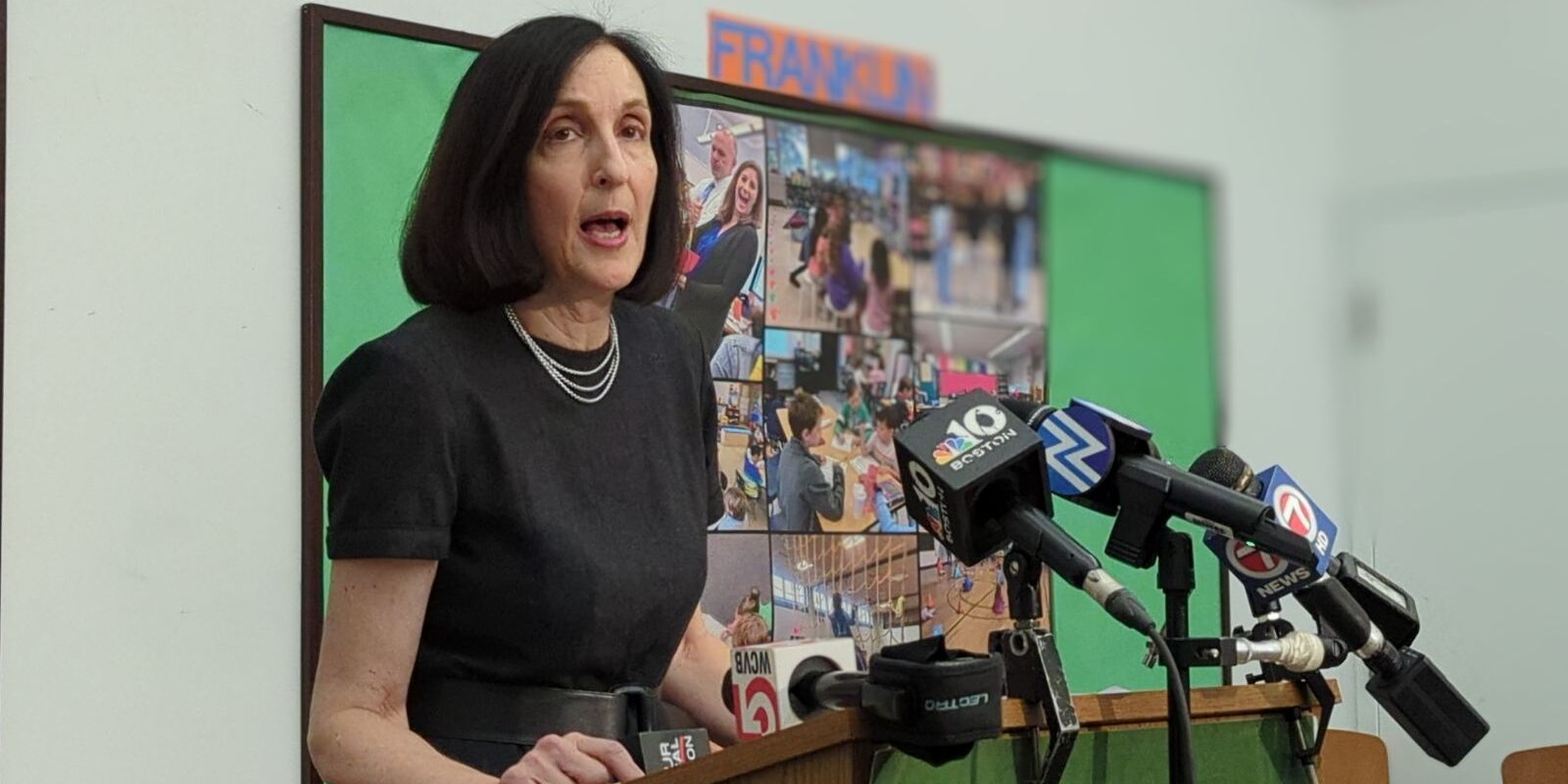
Mayor Ruthanne Fuller speaks to reporters during the January 2024 teachers’ strike. Photo by Bryan McGonigle
School’s out
The NTA wanted bigger cost-of-living pay increases, more social workers in the schools and other improvements teachers say were needed to deal with the impact from the pandemic. Fuller, who allocates money for the schools, and the School Committee, insisted that without that operating override, the NTA requests weren’t possible.
In January 2024, the NTA declared a strike. That strike lasted two weeks.
“The week leading up to it, the two weeks of the strike and the weeks after were all very difficult,” Fuller said. “A core service is teaching our young ones. It’s a core principle for the city of Newton. We all care deeply about our children, and the individual teachers who teach our kids are honorable, good people.”
Things got ugly. Supporters of the union accused Fuller of hiding millions of dollars while others accused the NTA of using their kids’ education as a political game piece. Parents and union members scuffled. The School Committee chair broke down in tears during a press conference. And at the center of it all was Mayor Fuller, who wouldn’t budge.
“You have to balance a budget, and you have to keep the increases in compensation in line with your increases in revenues,” Fuller said with a smile and as much conviction as she had then. “And strikes were, and still are, illegal in Massachusetts.”
Eventually, Fuller and the NTA reached an agreement for many of the NTA demands to be met with a new education stabilization fund, and the strike ended.
Newton fared better than other communities that had recently seen teacher strikes, including Andover and Brookline, which saw massive teacher layoffs after their bargains were reached. But distrust in government institutions grew.
This year, the schools faced another budget crisis, as the amount of money Superintendent Anna Nolin requested to keep school services level was millions of dollars more than what Fuller was allocating to the schools for Fiscal Year 2026.
School funding advocates have accused Fuller of prioritizing buildings over teachers and students, especially with the American Rescue Plan Act money. Nearly a third of the ARPA money—around $20 million—went toward school-related items, but only $4 million of that went to city and school employees.
For Fuller, renovating and upgrading buildings and fields is a logical use for one-time funding.
“Those cities or schools that use the one-time funding for ongoing costs have even had worse situations now laying off people,” she said. “So, while it’s very tempting, and in the moment it feels like you should be doing it, it doesn’t take an MBA to understand why you don’t do that.”
In May, after months of parents demanding the mayor put more money toward the schools, after weeks of the superintendent ferreting for cost savings, and after the School Committee voted to approve Nolin’s budget request instead of Fuller’s lower recommendation, all sides were able to reach a compromise that kept the schools intact.
But that compromise came with a resolve to fix the underlying budgeting issues that kept bringing the NPS community to its knees.
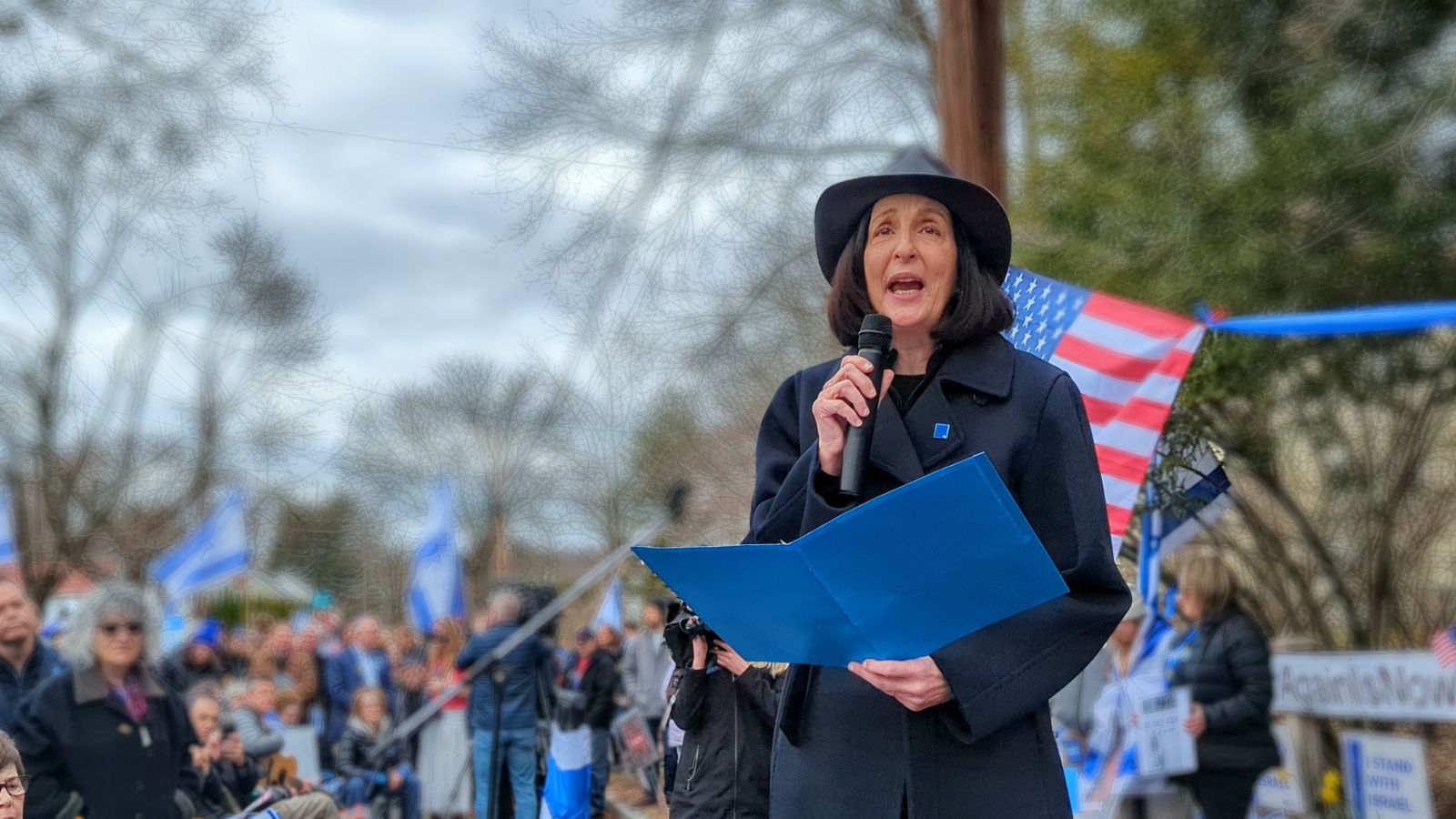
Mayor Ruthanne Fuller speaks at a rally against antisemitism on Sunday, April 7, 2024. Photo by Bryan McGonigle
Thermostat rising
In 2021, a 28-year-old man named Michael Conlon entered a candy store in Newton Highlands brandishing a knife.
When police arrived, they ordered him to drop the knife and tried using rubber bullets and a Taser to subdue him. When that failed, an officer shot him with a gun, and Conlon died.
An investigation found that the officer acted appropriately, and Fuller stands by the police.
“From everything I’ve learned, both that day and subsequently, I certainly feel very badly for the Conlon family,” Fuller said. “It’s a terrible loss for those parents. But given the weapon involved, the situation that was faced, I support our officers in that terrible situation, and I know it’s the absolutely last resort for them.”
In 2023, the city faced another violent tragedy when a man murdered a Nonantum couple celebrating their anniversary, along with the husband’s elderly mother.
Both tragedies highlighted the rising mental health crisis in America, which many believe was exacerbated by the isolation that came with the pandemic.
Fuller doesn’t try to hypothesize the causes of those particular incidents. “I don’t know the particulars with those cases, but I think, across demographics, across age groups, people understandably are more anxious today, more worried,” Fuller said. “They feel in general, their lives, and the world is less stable.”
And in some ways, it is. A few months later, after Israel was attacked by Hamas in October 2023 and Israel began an enhanced military operation in Gaza, emotions in America began to boil over. Newton police saw a dramatic spike in hate crimes, particularly against Jewish homes and organizations, and both Jewish and Arab students reported being bullied.
In the summer of 2024, that tension erupted when a pro-Israel activist from Framingham shot a pro-Palestinian activist while the two scuffled on the ground in Newtonville.
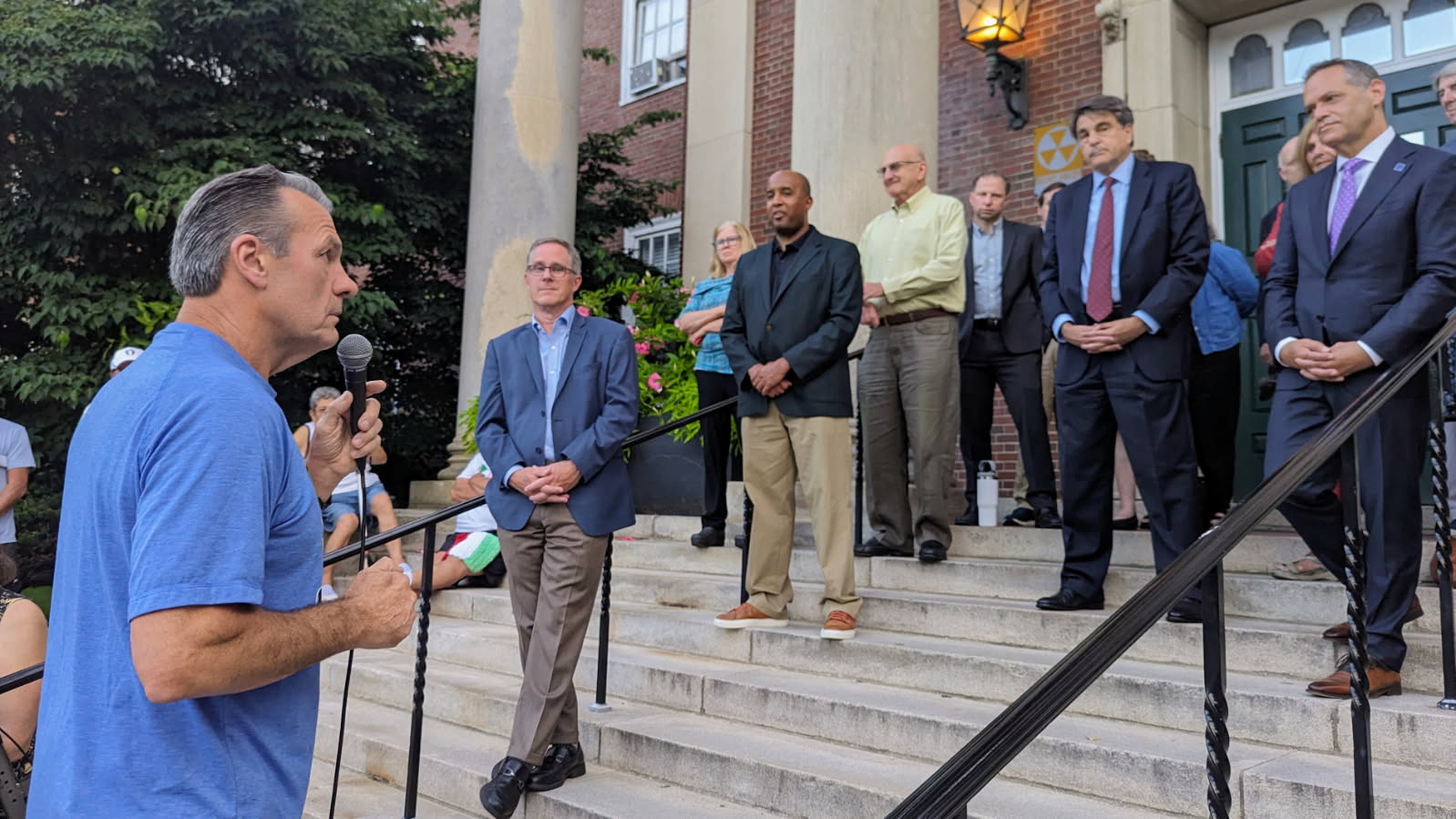
Nonantum resident Kevin Rife, joined by dozens of his neighbors, asks city councilors to draft a resolution calling on Mayor Ruthanne Fuller to have the red, white and green lines repainted on Adams Street on July 14, 2025. Photo by Bryan McGonigle
Lines crossed
The following summer didn’t include any murders or shootings. But the rise in temperature brought a battle of biblical proportions over street lines and heritage in Nonantum.
One night in June, Adams Street residents noticed a street repair crew blasting the red, white and green lines—painted every year in honor of Nonantum’s Italian-American history.
This was just three weeks before the St. Mary of Carmen Society’s 90th Italian-American Festival.
Fuller said the lines needed to be replaced with two yellow lines because of how much traffic that street gets. Opponents accused her of using especially busy dates to report that street’s traffic in an effort to justify the removal of the Italian flag-colored lines, which mayors have allowed residents to paint down the middle of that street for decades.
Fuller insists that she didn’t know what date the line removal would be done. Asked if there’s anything she would have changed about that situation, Fuller said she would have communicated better.
“It was a surprise to many of us, the exact date where the lines got blasted off, so we absolutely missed the mark on communicating when it was going to happen,” she said.
Fran Yerardi, an outspoken critic of Fuller throughout the ordeal and beyond, said the incident showed a pattern of stubbornness.
“Mayor Ruthanne Fuller’s legacy is not defined by a lack of effort or conviction. If anything, it is defined by an abundance of both,” Yerardi said. “She governed with absolute certainty in her own judgment, and once she believed she was right, opposing views—whether from her trusted advisers, subject matter experts, or residents—rarely altered her course. Compromise was rarely part of the equation. She stood her ground to the end. That governing style shaped her tenure and ultimately defined it.”
Reflections on a legacy
Around Newton, people often use the same concepts to compliment Fuller that others use to criticize her.
Some, like Yerardi, say she’s stubborn to a fault, while others say she stands her ground. Some say she’s gone too far with the number of bike lanes she’s had installed, while others say she’s taking initiative with bicyclist safety. Some say she prioritizes buildings over employees, while others say those employees need buildings and capital improvements benefit the city for generations to come.
Every mayoral administration is marked by the economic realities of their time. Setti Warren’s was one of low inflation but increasing enrollment in the Newton’s public schools, while Fuller’s was one of high inflation and declining school enrollment—and, of course, a pandemic and record-breaking teacher strike.
It’s enough to justify anyone’s decision to call it quits. But Fuller said her choice to not run again—in addition to wanting to spend more time with her grandkids—had more to do with accomplishments than challenges.
“Almost everything that I laid out on Jan. 1, 2018, we had either done or made significant progress on,” she said. “So my checklist of items was largely checked, and so I felt good about leaving the city at this time.”
She wouldn’t speculate on who may have won—her or Marc Laredo—if she had run for reelection. Fair enough. But she did say that she has confidence that Laredo, who is set to take office on Thursday, will lead with love for the community.
“Marc loves the city. He will work hard,” Fuller said. “Continuous improvement is the nature of government. I wish him all the best. He’s got a great team of people around him, and I’m a phone call away if there’s anything I can ever do to be of help.”
She met with Laredo and city councilors for dinner last week and shared with him a quote by President Lyndon B. Johnson: “When the burdens of the presidency seem unusually heavy, I always think it could have been worse. I could have been mayor.”
This week, Fuller’s political story, which started on a neighborhood association and ended with two terms as the city’s first woman mayor, comes to a close. And what a journey she’s had.
How does someone define a legacy for an administration that endured multiple crises while transforming the way the city builds, the way the city moves, and the way the city plans? That might be the legacy in and of itself.
Balser said Fuller’s legacy will include one of protection.
“Mayor Fuller’s passions for protecting Newton’s natural environment, as she did when fighting to keep Webster Woods, and for protecting the health of the city’s finances has characterized the mayor during her years of public service,” Balser said. “That’s a legacy to be proud of!”
For Laredo, it’s her work ethic.
“Mayor Fuller has been from day one, and continues right up until the end of her term to be, an exceptionally hard worker, really dedicated to the well-being of the city,” Laredo said. He, too, pointed to tangible legacies like the Cooper Center, the athletic fields, the new school buildings. But he also praised her poise under pressure throughout the COVID-19 pandemic.
“I have tremendous respect and admiration for Mayor Fuller on every level,” he said. “She’s a really good person who was a great person to work with when I was a city councilor.”
For Yerardi, Fuller’s legacy will be a double-edged sword.
“In battles worth having, she was formidable,” Yerardi said. “But leadership is not measured only by how hard one stands their ground—it is also about knowing when to listen, when to adapt, it is measured by knowing when standing alone costs more than compromise. That is the paradox of Ruthanne Fuller. Her steadfastness could either protect the city or divide it. Her conviction could inspire confidence or provoke conflict. Her governing style never altered—only the circumstances did.”
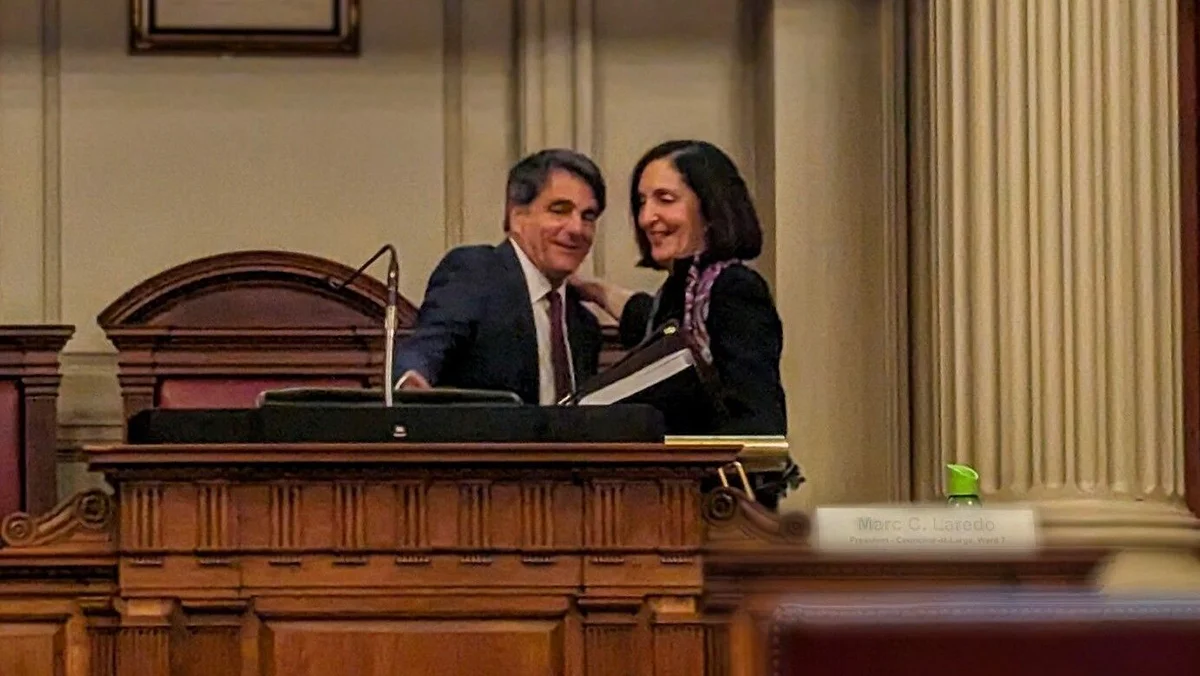
Newton City Council President Marc Laredo greets Mayor Ruthanne Fuller as she gets ready to present her 2025 budget proposal on April 16, 2024. Photo by Bryan McGonigle
How would Fuller define her legacy?
“There’s the hard side and the soft side of the legacy,” Fuller said.
The “hard side” includes tangible things like buildings and infrastructure. And there are plenty of things to point to in that respect: structural additions at Day Middle School and Horace Mann, new Countryside, Lincoln-Eliot, and Franklin school buildings, new synthetic turf fields and the Cooper Center, to name a few.
It also includes things like the anticipated renovation of the Newtonville commuter rail station, the two pools at Gath and the improvements made to West Newton Square and Pettee Square in Upper Falls.
What’s the “soft side?”
“We made significant progress on sustainability and on our zoning, real steps forward on housing, our human services, and our arts and culture took real steps forward,” she explained.
If Mayor Ruthanne Fuller today could meet with the 2009 Ruthanne Fuller as she was preparing to run for alderman, what would she say?
While the world has changed so much since then, the fundamentals of good governance and community service have survived.
“The pandemic shook up the world so dramatically, and not only did it mean that children weren’t in-person in schools or older people weren’t in-person with their neighbors, there were a couple of years there where I also couldn’t be in-person with people,” Fuller said. “So, it was true in 2009 and it’s true in 2025: If you can respond to an email with a phone call, that’s better. And if you can respond to a phone call by being together in-person, that’s better. Just keep being together. Listen with an open heart. Always be as respectful and empathetic as you can.”
Share This Story On:
DONATE TO SUPPORT LOCAL NEWS
Your tax-deductible gift to the Newton Beacon keeps our community connected and its residents informed.
Get story alerts
twice a week:
Related Posts




Upcoming Events