
homer2
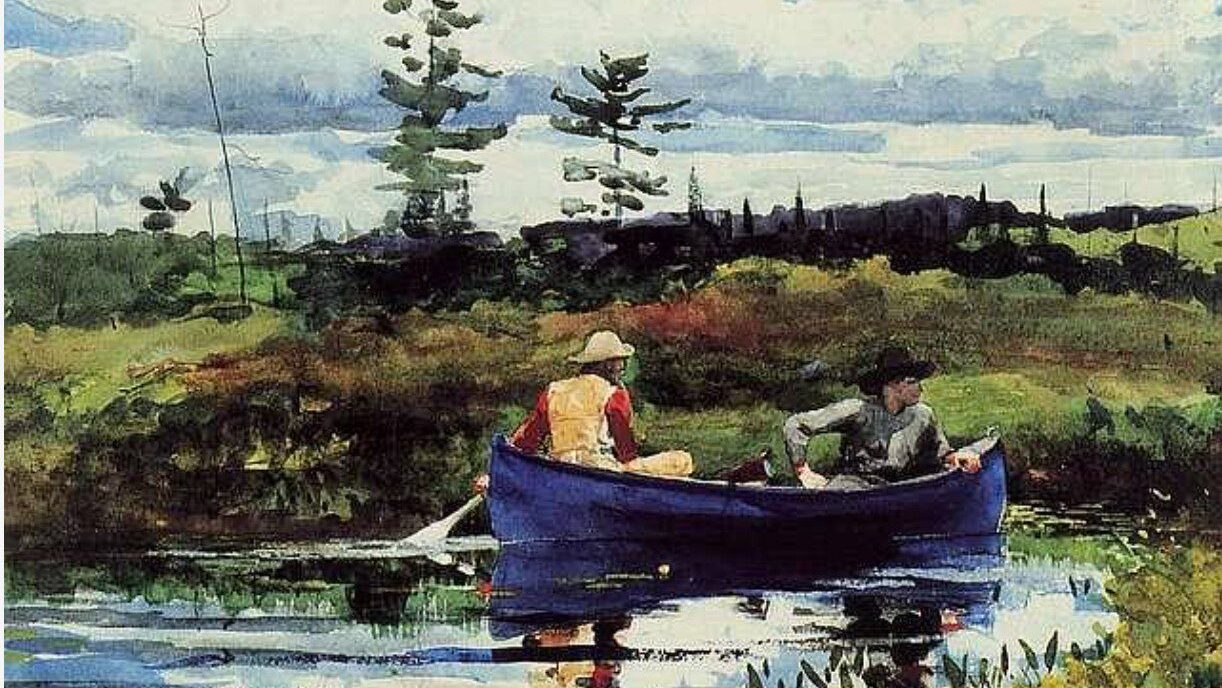
"The Blue Boat," 1892, a watercolor painting by Winslow Homer. Public domain image
You might have seen advertisements for the Winslow Homer exhibit currently on display at the Museum of Fine Arts in Boston. Homer, born in Boston and raised in Cambridge, had an illustrious career as a landscape painter and illustrator. The exhibit offers a rare chance to see his watercolors; many are usually kept in storage to protect them from light-related fading. But what you might not know is that Homer’s career rested on the patronage of his childhood friend, who spent much of his adult life in Newton. That man was Lawson Valentine, who also made a career out of painting, but in a very different way: selling commercial paints and varnishes.
You may know his firm as Valspar. And if you’ve ever driven on Valentine Street in West Newton, you’ve been on the road that Lawson once called home.
The Homers lived on the same street in Cambridge as the Valentines. Lawson was eight years older than Winslow, and six years older than Winslow’s brother, Charles. In 1847, when he was 19, Lawson began working in the paint industry in Boston. He would soon marry his fellow Cantabrigian Lucy Heywood Houghton, and in 1860, they moved to Newton, purchasing a home and 15 acres of land. His mother and brother would follow and live elsewhere in Newton.
The Valentine home was at the same location as the very first house ever built in West Newton, and likely contains some of its hand-hewn timbers. The Valentine house would be moved to what is now 12 Valentine St. to accommodate the building of Charles Travelli’s mansion.
But Lawson wanted more. In 1867, he and his brother Henry were now running their own firm, Valentine and Company. Lawson made a boast: he would produce varnish that would outcompete British varnish, which was acknowledged by all to be of superior quality to anything Americans could produce.
This was not something he could actually back up when he initially claimed it. The American varnish industry really was behind. Lawson’s head varnish maker would drop a potato in to judge whether or not the varnish was ready. But Lawson knew who to hire: his childhood neighbor Charles Homer, now a Harvard-educated chemist. To us today, this seems logical. But at the time, this was innovative. Harvard did not even have a scientific school until 1847, and the field of industrial chemistry was small. Lawson’s gambit paid off, and the company prospered.
This would be good for Winslow’s career. He had learned lithography through an apprenticeship in Boston, and Lawson had once commissioned him to create a woodcut of the Valentine varnish factor. Winslow had become a successful illustrator for Harper’s Weekly.
They hired him as a full-time war correspondent during the Civil War, and his work drew such acclaim that he was elected as an Academician of the National Academy of Design when he was only 29. But he was also an oil painter, and unlike illustration, to make a living as a successful painter generally requires wealthy patrons who want to buy one’s paintings. Lawson would be one of those early patrons for Winslow, first buying an 1866 painting called Army Teamsters. He and his wife would go on to purchase over 50 of Winslow’s paintings. Winslow became interested in watercolors after his mother Henrietta’s watercolors of flowers were on display at the Brooklyn Art Association in 1873. This would become what he was well known for, more so than oil paintings or illustration. Lawson would buy his watercolors as well, and he would also invite Winslow to the Valentine family’s country estate, Houghton Farm, about 60 miles north of Manhattan. There he would paint many of his pastoral scenes.
The farm would not be as good for Lawson. After a business associate defaulted on a loan, Lawson had to sell his share of the varnish company to pay his debts, many of which he had accrued from agricultural expenses. But this allowed him to focus more on the publishing firm he had an interest in, Houghton Mifflin, founded by one of his wife’s relatives.
At this point, he was primarily living in New York City, where the publishing firm was located, and by 1890 he had sold his Newton home (although his wife continued to own land on Valentine St.). Homer also moved out of Massachusetts, having established a studio in Maine, where he painted many scenes of waves against the rocky beaches of Scarborough. But good Cantabrigians both, they desired the same final resting place: Mount Auburn Cemetery in Cambridge.
The exhibit runs through January 19, and the museum is free on the 19th, Martin Luther King Jr. Day. Exhibit tickets are included with MFA admission, but tickets are time-entry required due to space limitations, so plan ahead.
It’s well worth seeing. His watercolors and oil paintings are lush representations of nature, with leaping brook trout and crashing waves against New England coastlines. There are other paintings that are within the standard fare of 19th century art, like romantic depictions of rural life. But his illustrations are also on display, as well as oil paintings of the Civil War, like a soldier pretending to be sick in front of the camp doctor.
And he painted other scenes that are more evocative than the trout: white children looking into the tiny home of a black family after Reconstruction, for example, or a Bermuda beach with tiny British regulars in their red coats, there to oversee prisoners of war taken during the Anglo-Boer War. There’s also a high school doodle he did of a rocket ship, and some watercolors by his mother Henrietta.
Share This Story On:
DONATE TO SUPPORT LOCAL NEWS
Your tax-deductible gift to the Newton Beacon keeps our community connected and its residents informed.
Get story alerts twice a week:
Related Posts



Upcoming Events