
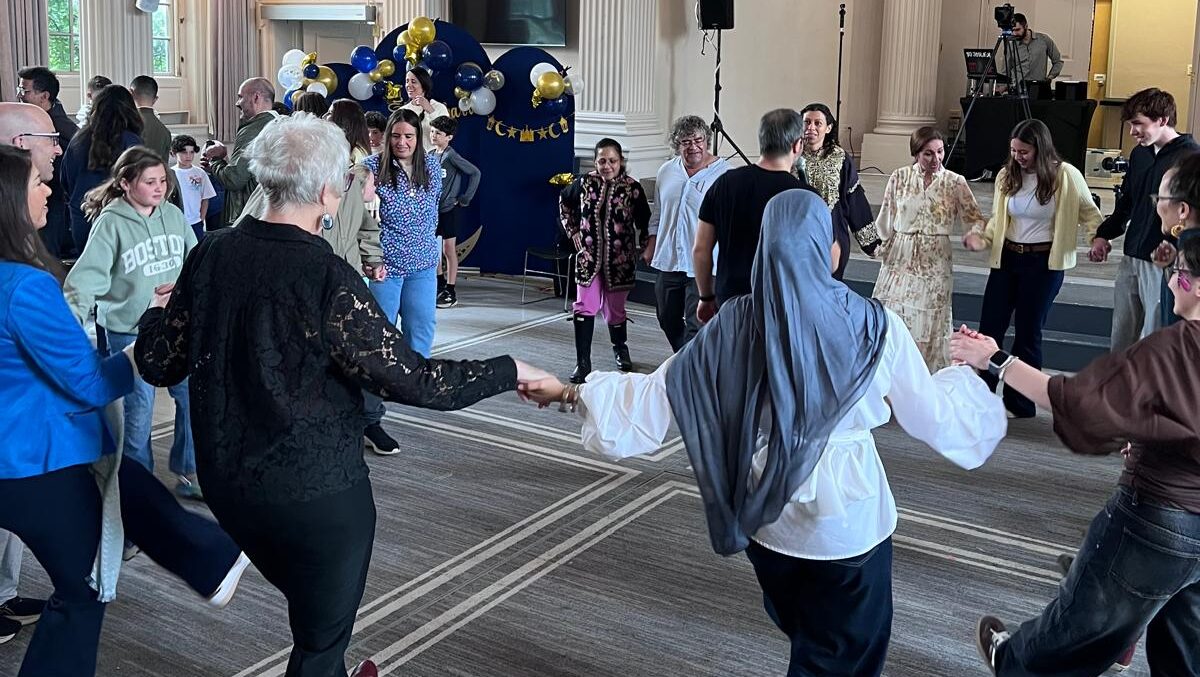
eid
Attendees at an Eid celebration at Newton's City Hall War Memorial learn Dabke, a traditional Levantine group dance. Courtesy photo
The Newton Beacon recently reported on a letter attacking Newton’s Eid-ul-Adha celebration at City Hall. The article correctly noted that the May 29 letter named groups that were not listed as sponsors of the Eid event, discussed events outside Newton, and failed to explain how the Newton celebration itself was supposedly tied to terrorism.
But given the gravity of the accusation, that was not enough.
The letter did not merely criticize a city permitting decision. It accused a Muslim community celebration—one attended by families, children, neighbors, city officials and community members—of being connected to “terror funding.” That is an explosive allegation. It carries real consequences. It can stigmatize Muslim residents, chill civic participation, and make ordinary families feel unwelcome in their own city.
When a local newspaper reports such accusations, it has a responsibility not only to quote them, but to test them.
The Beacon story gave readers the general shape of the controversy, but it did not meaningfully examine whether the letter’s claims were true. It did not walk readers through the footnotes. It did not distinguish between a proven fact, a political allegation, an advocacy claim, a foreign government designation, a congressional request for investigation, and an actual U.S. legal finding. Those distinctions matter. They matter because the letter’s argument depends on blurring them.
The letter uses a familiar chain of guilt-by-association: an Eid celebration was supported by an Islamic center; the Islamic center has had contact with or links to various Muslim charities or organizations; some of those organizations have been criticized or accused by third parties; therefore, the Eid celebration itself becomes suspect.
That is not evidence. It is insinuation.
A serious fact-check would have asked basic questions: Was any terrorist-designated entity an organizer of the Newton Eid celebration? Was any sanctioned organization a sponsor, vendor, speaker, beneficiary or recipient of funds? Did the event raise money for any prohibited cause? Did the City transfer funds to any unlawful entity? Was there any law-enforcement warning about the event? Did the footnotes actually support the claims being made?
Based on the letter itself, the answer appears to be no.
Some of the cited sources do not prove what the letter says they prove. Some are allegations or requests for investigation, not findings. Some concern events that did not happen in Newton. Some concern organizations that were not listed as sponsors of the Eid celebration. Some rely on broad ideological claims rather than concrete event-specific evidence. And some claims are several steps removed from the actual families who gathered at City Hall to celebrate one of the most important holidays in Islam.
That distinction should have been front and center.
This is not a call for the press to ignore controversy. Quite the opposite. The press should report on community disputes, especially those involving public buildings, city officials and civic inclusion. But when a group levels accusations as serious as “terror funding,” journalism cannot stop at “one side said this, the other side said that.”
Repeating a smear without testing its foundation risks laundering innuendo into public discourse.
The issue is not whether Newton should have neutral standards for public events. It should. The City can ask who is organizing an event, who is funding it, whether money is being raised, whether permits and insurance are in order, whether safety plans are adequate, and whether any formal beneficiaries are legally prohibited entities. Those are fair questions, and they should be asked consistently of every group.
But that is very different from treating Muslim residents as presumptively suspect because someone can assemble a dossier of unrelated controversies involving Muslim organizations elsewhere.
No Jewish holiday celebration should be judged by the most controversial organization someone can associate with Jewish public life. No Christian, Hindu, Sikh, Buddhist, secular or cultural event should be judged that way either. Muslim residents deserve the same standard.
Newton’s first public Eid celebration was a civic milestone. It was a statement that Muslim families are part of the fabric of this city. It deserved coverage. If some residents objected, that deserved coverage too.
But the allegations deserved scrutiny, not just amplification.
At a time when antisemitism and Islamophobia are both real and dangerous, local journalism has an especially important role to play. It should lower the temperature by clarifying facts. It should help readers distinguish between legitimate safety questions and collective suspicion. It should not allow the language of public safety to become a vehicle for casting an entire faith community under a cloud.
The Beacon took a useful first step by noting that the May 29 letter failed to connect its allegations to the actual Eid event. But when accusations this serious are made against a minority community, readers need more than a summary of the dispute. They need verification. They need context. They need clarity.
They need journalism that says plainly: extraordinary accusations require evidence, and guilt by association is not evidence. Newton should stand for safety, truth and equal belonging. Our local press should hold itself to the same standard.
Zaid Ashai
Newton, MA
****
Editor’s Note: The article in question did note that the accusations were unsubstantiated, and the city’s advertisement for the event, while listing corporate and nonprofit sponsors, did not list a separate group that was organizing it. The link to the disturbing letter was initially included as a reference but then removed so as to not spread the letter further than it had gone online and on social media.
Share This Story On:
DONATE TO SUPPORT LOCAL NEWS
Your tax-deductible gift to the Newton Beacon keeps our community connected and its residents informed.
Get story alerts twice a week:
Related Posts



Upcoming Events