
AntisemitismRally2
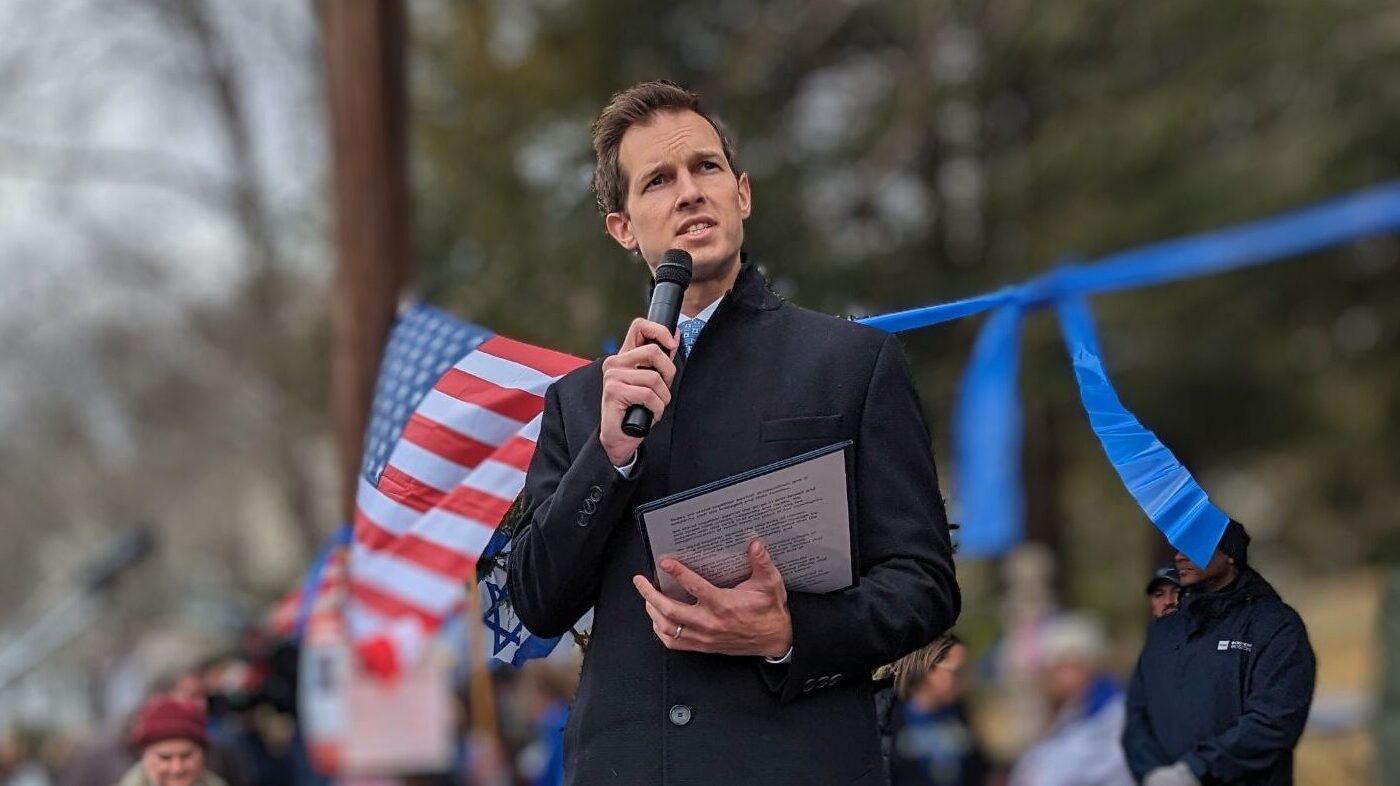
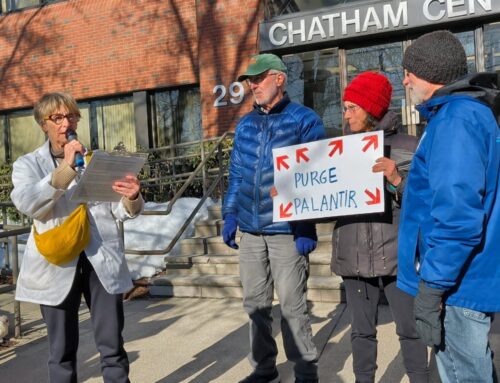
U.S. Rep. Jake Auchincloss, D-Newton, speaks at a rally against antisemitism on Sunday, April 7, 2024. Photo by Bryan McGonigle
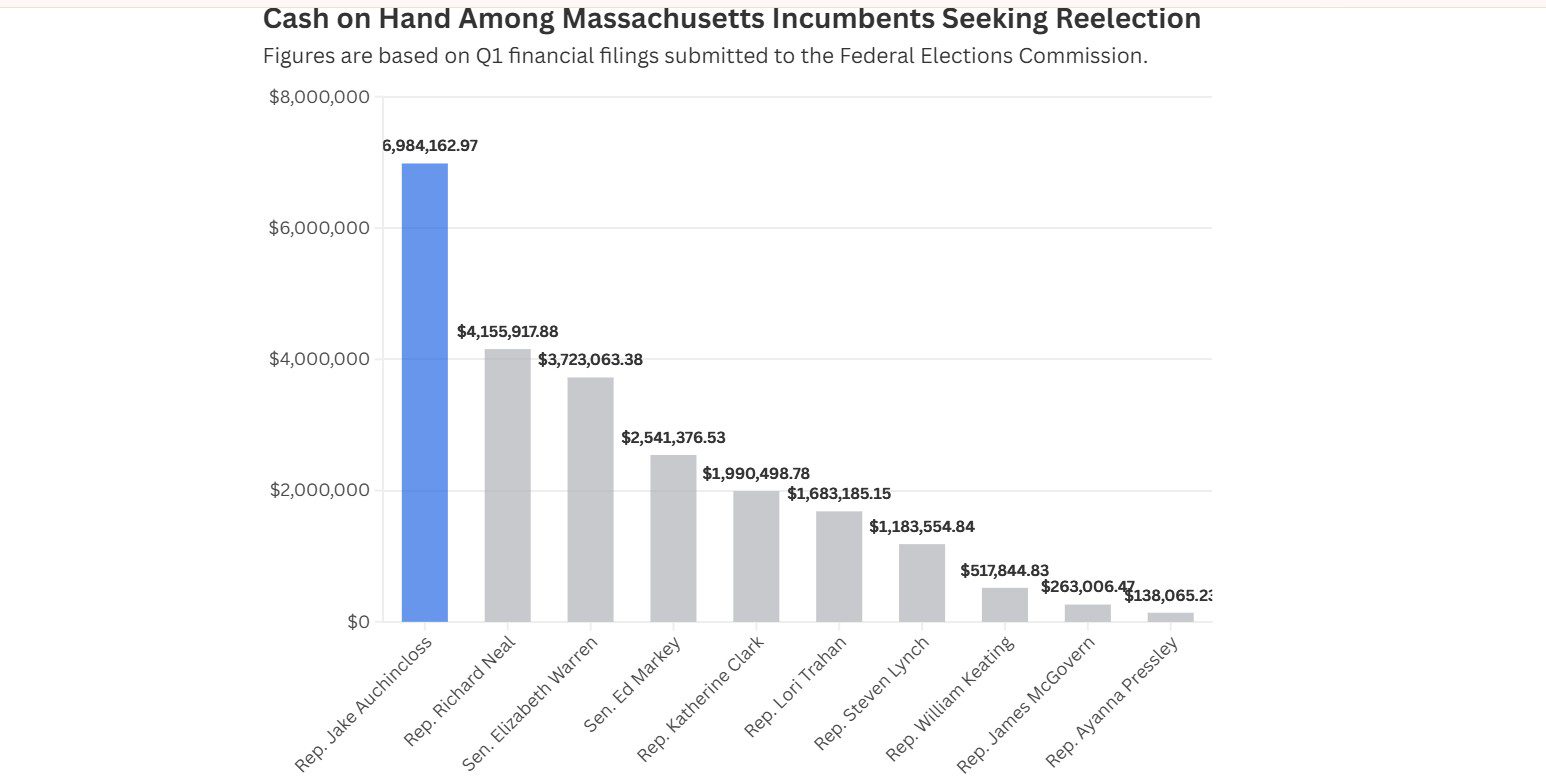
Democratic Representative Jake Auchincloss (MA-4) amassed the largest campaign war chest of any Massachusetts congressional member and one of the largest in the country, with nearly $7 million in cash on hand, according to the latest campaign finance disclosures.
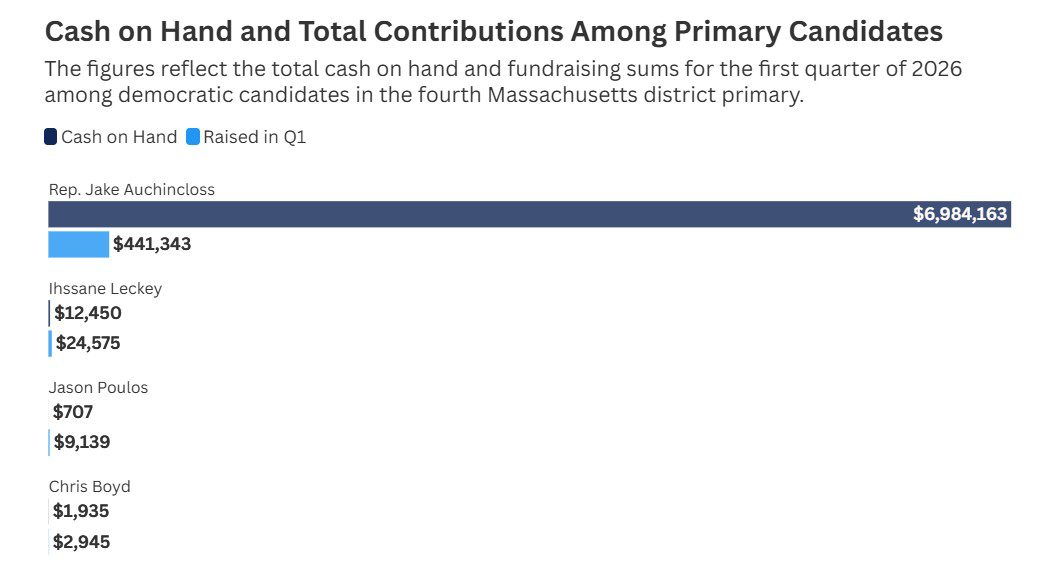
The Massachusetts Democrat dwarfed his primary challengers in total campaign contributions in the first quarter of 2026, raising more than $440,000 with a significant total proceeding from Political Action Committees (PACs).
His campaign reserves now rank seventh among House members nationwide and trail behind high-profile fundraisers like Representatives Ro Khanna, Ritchie Torres and Alexandria Ocasio-Cortez.
Source: Federal Election Commission
Auchincloss maintains deep financial reserves as the state’s 2030 Senate race begins to take shape.
In September 2025, after months of consideration, Auchincloss ruled out challenging incumbent Senator Ed Markey, who is currently seeking reelection.
Representative Seth Moulton (MA-6), who is currently running against Markey, has $3,330,000 cash on hand.
Auchincloss has declined to issue an endorsement in the contested Senate primary.
Incumbent Senator Elizabeth Warren has not said whether she will seek a fourth term in 2030 when she will be 81.
In the race for the Congressional District seat, Auchincloss faces his two active primary contestants with a financial advantage.
Ihssane Leckey emerged as the top fundraiser among Auchincloss’ challengers in the first quarter of 2026—despite suspending her campaign in early April—reporting over $24,500 in contributions. Jason Poulos followed with slightly more than $9,100, while Chris Boyd brought in nearly $3,000.
Combined, the three opponents raised less than 1 percentage point of what Auchincloss holds in reserves.
Source: Federal Election Commission
Jeremy Rasmussen, campaign manager for the Poulos campaign, acknowledged the difficulty of competing with Auchincloss’s fundraising totals.
“I’ve been trying to be very clear about what we actually need money for and where we need to spend money, because at the end of the day, if the incumbent has millions in his first quarter FEC filings—which he does—I’m going to do my best,” Rasmussen said in an interview with The Heights. “I don’t know if I’m going to get to millions. I’m not trying to talk myself down. It’s going to be hard to get there.”
About $5,000—just over half of the Poulos campaign’s quarterly fundraising—came from candidate self-funding. Leckey and Boyd similarly relied on personal contributions, which accounted for roughly 32 percent and 11.6 percent of their totals, respectively.
The remainder of their fundraising came exclusively from small-dollar donors giving less than $200.
By contrast, Auchincloss drew the majority of his contributions from donors giving $2,000 or more. About $139,000 came from PAC-earmarked donations, accounting for more than 30 percent of his quarterly total.
Donations from pharmaceutical and medical companies also represented a sizable share, exceeding 10 percent.
The Poulos campaign acknowledged the disparity in funding sources and framed its reliance on small-dollar donations as a sign of grassroots support among voters.
“A lot of the people who we’re most trying to give a voice to are the people who are the most financially destitute and therefore don’t have the money to give to us,” Rasmussen said.
Poulos directed the bulk of his campaign spending toward advertising—the only candidate in the field to do so. Notably, his campaign reported a $200 ad buy on Grindr—an LGBTQ+ matchmaking application.
While Auchincloss expended roughly $150,000 this quarter, about $120,000 was transferred to the Democratic Congressional Campaign Committee (DCCC).
Leckey reported approximately $12,000 in administrative campaign expenses, and Boyd about half of his total receipts. Leckey’s campaign also carried more than $40,000 in outstanding debt obligations.
In challenging Auchincloss for his seat, Boyd has focused his messaging on broader institutional grievances, arguing that current politicians are “not fighting for everyday people.”
Meanwhile, Poulos has taken a more direct approach against the incumbent, with his campaign criticizing what it describes as Auchincloss’s disingenuous and flippant politics on issues like the Iran War.
In public statements, Auchincloss has condemned the Trump administration for failing to obtain Congressional approval before the start of hostilities and decried an incoherent strategy for the conflict, lacking long-term goals.
Auchincloss, however, has not offered a clear position on his support for the conflict at large or attempts at regime change in the Islamic nation.
****
This story is from The Heights, an independent, nonprofit newspaper run by Boston College students with which the Newton Beacon has a partnership.
Share This Story On:
DONATE TO SUPPORT LOCAL NEWS
Your tax-deductible gift to the Newton Beacon keeps our community connected and its residents informed.
Get story alerts
twice a week:
Related Posts




Upcoming Events