

AROUND NEWTON
When Newton residents open their faucets, they expect safe, clean water.
“People like to turn on their water and have it work,” says Shawna Sullivan, the city’s commissioner of public works. “It affects every household in Newton.”
We take the water in Newton for granted, but is that reasonable?
Few residents know where our water comes from, how it’s treated, and what discolored water means. But a better understanding of Newton’s water might make them think twice before buying a case of bottled water.
Newton is fortunate to receive its water supply from the Massachusetts Water Resources Authority (MWRA), which owns a system of reservoirs, mainly the Quabbin Reservoir and Wachusett Reservoir west of Boston. These reservoirs are surrounded by forests, so the water is high quality from the start. The MWRA treats the water using chlorine, ozone and ultraviolet light to kill bacteria and parasites, and then sends it to the Boston metropolitan area via aqueducts.
Thousands of tests for bacteria, lead, “forever chemicals” called PFAS, and other contaminants, carried out annually by the MWRA, confirm that the water entering the region’s water mains is of exceptionally high quality. The City of Newton also tests water weekly at two dozen sites, and those results also show excellent water quality. Test results are available to the public on the MWRA and City of Newton websites.
Newton water mains tap into the aqueducts at various points and distribute water to five separate water districts. Water is pressurized using a combination of gravity, pumping stations and water towers. The main pumping station is on Commonwealth Avenue near the main library, and the two water towers are located on Waban Hill in Chestnut Hill and on Oak Hill above Dedham Street.

Newton’s main pumping station. Photo: Richard Primack
Built over a century ago, Newton’s water distribution system requires constant inspection and maintenance by the Utilities Division of the Department of Public Works to ensure quality and reliability. A key feature of the system is redundancy, so water service can continue even if parts of the system are being serviced or replaced.
Maintenance involves inspecting and replacing water valves, fire hydrants and water mains (many of which were made of cast iron and have become corroded). The city has allocated $5 million per year for this activity. In addition, the system is periodically flushed with high velocity water to remove accumulated sediment.
Because of the system’s age, there is a break or leak discovered somewhere almost every day in Newton. Breaks are repaired as soon as possible to minimize disruption. As Tom Fitzgerald, the city’s utilities director, put it, “My department is 24-7. We work around the clock when needed and are very responsive in fixing water breaks.”
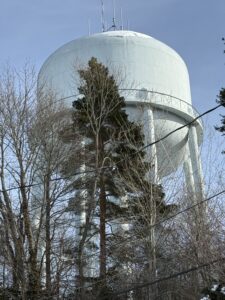
Oak Hill water tower. Photo: Richard Primack
On rare occasions, Newton residents may notice slightly brownish, greenish or milky white water. A brownish tinge can be caused when rust and other sediment get stirred up by the flushing process, and is more likely to occur in homes at the end of relatively inactive water lines. The city is taking actions to reduce the number of such inactive water lines.
A greenish tinge might be caused by algae in the water. And a milky color is due to an abundance of tiny air bubbles created when the water is aerated during flushing. In all three of these situations, the water is still safe to drink.
Lead contamination of water can occur in old houses where lead solder was used in the plumbing or water service line. Contamination can occur if water remains in the system overnight and then people drink the first water coming out of the faucet in the morning. To avoid this, simply run the water for a few minutes each morning or fill a pitcher with water the evening before. Also, never drink from hot water taps, as heat dissolves lead and other contaminants more easily.
For Newton residents, there is really no need to drink bottled water or to filter the water, unless someone has special medical issues.
Jim Harper, a Newton resident for over 50 years, agrees, “We’ve never used filters or bottled water. We’ve always had a high regard for our MWRA water.”
Given the extensive testing, monitoring and maintenance that’s done on Newton’s water system, residents can indeed count on receiving safe and reliable water from their faucets.
Richard B. Primack is a lifelong resident of Newton and plant ecology professor at Boston University. He can be reached at: primack@bu.edu
Share This Story On:
DONATE TO SUPPORT LOCAL NEWS
Your tax-deductible gift to the Newton Beacon keeps our community connected and its residents informed.
Get story alerts
twice a week:
Related Posts










Upcoming Events