
Pilot1
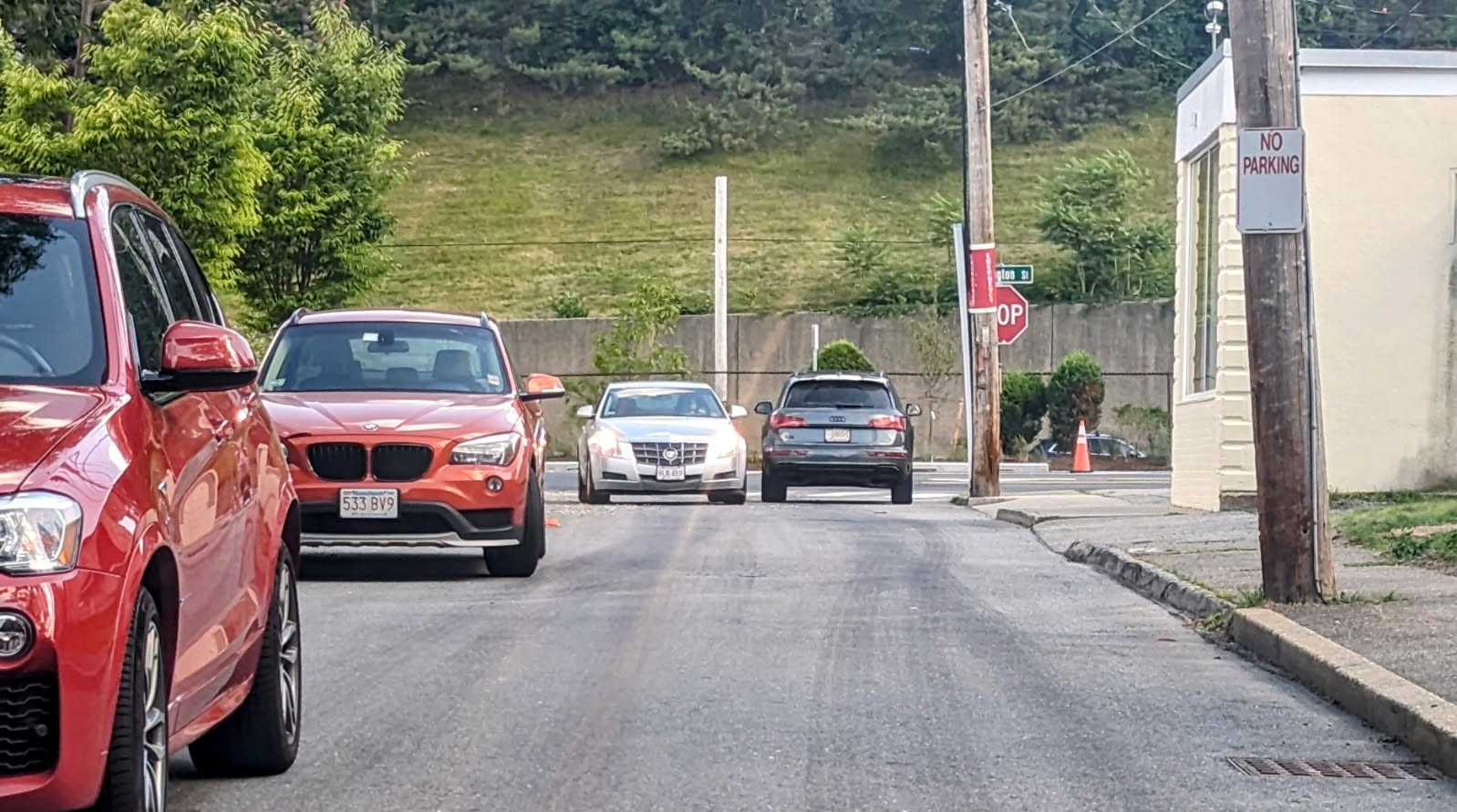
Drivers engage after a near collision at the intersection where Washington Street meets Cross Street, a side street that has previously seen an uptick in traffic and where space has become tight. (Photo by Bryan McGonigle)
Anyone who has driven through Boston knows the feeling: a car cuts across two lanes with no warning, someone blocks an intersection even after the light changes, and a delivery truck seems to appear exactly where traffic is already at its worst. Boston drivers have a reputation for being impatient, aggressive and unpredictable.
While that reputation is sometimes exaggerated for comic effect, it also reflects a real problem. Driving in Boston is difficult not just because of individual behavior, but because the city’s streets, traffic patterns, weather and culture all combine to create a stressful driving environment.
One major reason Boston drivers seem so bad is that Boston itself is not an easy city to drive in. Unlike cities built on neat grids, Boston developed over centuries from old walking paths, colonial roads, filled-in land, and winding neighborhoods. As a result, drivers often face narrow streets, confusing intersections, sudden lane changes, limited parking, and rotaries that can feel like tests of courage. Even careful drivers can become uncertain when lanes disappear, signs are hard to read, or GPS directions arrive too late. In that environment, hesitation and aggression can look almost the same.
Congestion makes the problem worse. Boston is a compact city with commuters, students, tourists, buses, cyclists, pedestrians, rideshare vehicles, and delivery trucks all competing for limited space. When people sit in traffic every day, they may begin to treat every gap as a personal opportunity and every delay as an insult. That mindset encourages rolling stops, blocking crosswalks, speeding through yellow lights, and refusing to let other drivers merge. The issue is not simply that Bostonians are rude; it is that the transportation system often rewards pushy behavior.
Why are we such bad drivers?
First there are too many cars. When I was a young father 30 or 40 years ago, we had one car. I drove my wife to work or to a subway stop, and I took the car back home; I worked at home or taught at the university for a few hours. Then I would pick up the kids and at times my wife. She usually took the T home. We lived in Brighton, near Beacon Street, so it was a short ride. But today, the wife wants her own car, and the children want a car, so we’ve gone from one car to three or four cars.
Second, there are too many “cultures” out there at war with each other. We have younger, faster drivers who are on the cell phone or GPS; we have a growing elderly population, and they tend to drive more carefully; there are drivers who love to tailgate; there are drivers who like to stop and let pedestrians cross while others make them scurry across.
We’re way too stressed. The outside world—war, genocide, the weather—impinges upon us.
We’re worried about our jobs, our debts, our school loans, our mortgage, plus the high cost of gas, food and entertainment.
Plus, there are simply too many mini-bikes, motor bikes, motorcycles, scooters and all kinds of wheelies and skateboards. Many of these drivers are young, as young as 14 or 15, and are unlicensed and have not taken any driver education courses.
This clash of cultures has led to bumper stickers like this one from a senior adult woman in Waltham driving her even older mother:
DRIVER IS OLD
CAN’T HEAR YOUR HORN!
CAN’T SEE YOUR FINGER!
*HAVE A NICE DAY*
What can we do about it?
One idea that I heard about comes from, of course, California. If you are ticketed for a moving violation or road rage, you have to take a mandatory short course using “I’m OK, You’re OK,” the famous 1967 book by Thomas Harris, and it’s the perfect antidote to road rage. It basically says that we need to understand the “Parent, the Child, and the Adult” ego states within ourselves:
– Repeat a mantra while you drive—any short phrase like “Ohmmm” or “Relax” (the word that I use).
– Do sense relaxation—tighten and then release your muscles starting with your toes and working your way to your neck and face—tense, release.
– Turn off the gas at long red lights. They do this in Japan, by the way. It saves gas and, surprisingly, decreases stress for some reason.
What can the state do?
– One, get rid of the “No Turn on Red” signs. They back up and slow down traffic.
– Have incentives to take public transportation, rather than punishment. Don’t charge people money to drive into the city but find a more positive incentive, like free Celtics tickets.
– Improve road signs and directional arrows on the roads. Fix the ones that are confusing. Have more overhead signs that show which lane to use.
But my #1 suggestion is a statewide campaign that I hope the governor will consider:
A “Be Nice, Drive Nice” campaign.
Put these signs up on the highways and by-ways of the Commonwealth. I think it will work. We’re not really “bad” drivers; we just have a very bad system of roads and stresses and that’s what makes us “mad.”
Jack Nusan Porter
Newtonville
Share This Story On:
DONATE TO SUPPORT LOCAL NEWS
Your tax-deductible gift to the Newton Beacon keeps our community connected and its residents informed.
Get story alerts twice a week:
Related Posts


Upcoming Events