


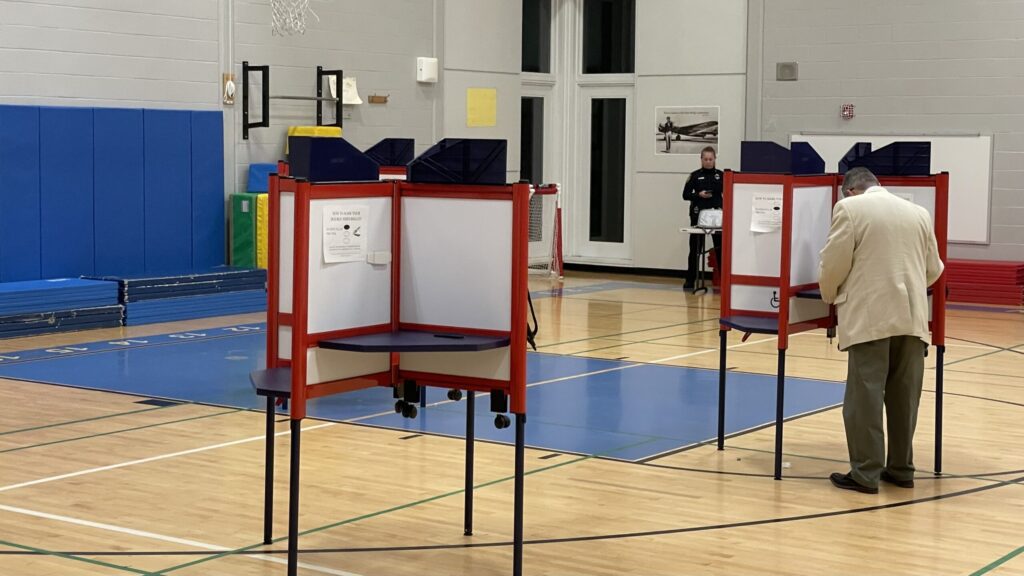
Voters on Nov. 3 will decide whether Massachusetts should overhaul its primary elections and create a joint primary in which the top two candidates with the most votes advance, regardless of political affiliation.
If Question 3 passes, all candidates for most state offices will be listed on the primary ballot rather than separated into parties, and any registered voter could participate. The two candidates with the most votes would advance to the general election.
In Massachusetts, elections currently start with candidates competing to win the Democratic and Republican primaries. The general election is open to the primary winners as well as independent and third-party candidates.
That system would be replaced by one in which all candidates – from the parties as well as independent candidates – would appear on the primary ballot, and the two top vote-getters would advance to the general election. As a result, the two final candidates could come from the same party.
For Massachusetts, a state that consistently votes blue, general elections could easily feature two candidates from the Democratic party.
Question 3 would apply to all state offices including governor, attorney general and legislators.
Supporters argue that Question 3 would lead to increased competition and therefore more accountability in elections. Opponents argue it would dilute diversity and strengthen the role of money in elections.
State Auditor Diana DiZoglio, whose position Question 3 would apply to, said she is voting “yes.”
DiZoglio said a top-two primary system would mean candidates stop “getting away with leaning on that party affiliation rather than doing the right thing, working hard, and winning the election on our own two feet.”
Evan Horowitz, executive director of the Center for State Policy Analysis, said the new system might increase competitiveness and drive candidates to focus on their policies.
Politically, Massachusetts is one of the least competitive states in the United States. Roughly 64% of state legislative elections between 2014 and 2025 featured candidates running unopposed.
“Right now, I say, you don’t have to do that,” Horowitz said. “You have to talk about what you believe in the primary, and then in the general just basically stand up and say, ‘Hey, I’m a Democrat.’”
Republicans, fearing the top-two primary would marginalize them, are largely opposed to Question 3.
“The Massachusetts Republican Party is absolutely, positively opposed to Question 3,” said Thomas Mountain, a Republican State Committee member for the district that includes Newton.
In 2025, Republicans made up 8.4% of registered voters. Democrats made up 25.8%.
“If this question does pass, we would be pretty much almost effectively discounted, although not formally.” Mountain said. “We simply would not be able to make it.”
Some Democrats dislike the bill too. Martina Jackson of Newton, a member of the Democratic State Committee, said she opposes it.
“If you have two Democrats or two Republicans running against each other, it bars the state party from doing anything for the candidates,” Jackson said. “So what do the parties do for candidates?”
The role of political parties would change with a new top-two primary system.
“It really would diminish the importance of political parties, in a way that the implications are hard to predict,” Horowitz said.
Under the current system, political parties play a big role in preparing separate party primaries. Question 3 would remove the separate primaries, meaning candidates would compete for the top two spots, removing the impact of a political party’s support.
“As somebody who has spent the majority of my life in running campaigns, I can tell you that this is really a problem,” Jackson said.
The risk of losing a political party’s power could deter some potential candidates from running for office, Jackson said, because many don’t have the financial or administrative resources to support a campaign. Jackson said this would cause money to play a larger role in elections.
“People are weary of the influence of money in politics,” Horowitz said.
An all-candidates primary would make both the primary and general election more competitive, driving more money into campaigns, Horowitz said.
California, Washington and Nebraska are the only states that have primaries in which the top two candidates advance to the general election regardless of party. Alaska and Louisiana use variations of that system.
A report by Unite America Institute found that the introduction of a top-two primary in California resulted in a more competitive election and, as a consequence, increased voter turnout.
“I hope going forward, we respect what these general elections are about, and what primaries are about, and that we honor the fact that Massachusetts has a two-party system, but also it has a system that allows for smaller parties to participate and be represented,” Jackson said.
****
This story is part of a partnership between the Newton Beacon and the Boston University Department of Journalism’s Newsroom program.