


Francis Le faces a dual monitor. One screen shows 3D modeling software, the other a photo of the Mario Kart race course “Rainbow Road.”
A senior at Newton North High School, Le is designing a bridge that will transition from a medieval one to “Rainbow Road” as a part of his drafting class project for the year—creating a fictitious city that follows the theme of “historic to futuristic.”
Down the hall, Newton North seniors Angelica Povkh and Nikolai Mandinov work in the graphics classroom. Mandinov embroiders 40 sweaters, while Povkh designs a banner with Adobe Illustrator.
Newton North doesn’t restrict learning to the typical classroom. Rather than sitting for hours sitting at desks, students in the Career and Technical Education programs take matters into their own hands—in a woodshop, professional kitchen, automotive shop and other areas.
CTE gives Newton students the opportunity to graduate with a major alongside their high school diploma. Programs range from drafting and design to carpentry and automotive technology.
And the program is growing. Newton North plans to add dental assisting, health assisting, and information support services and networking to CTE. The dental and information support programs will launch in January; health assisting is awaiting a release date.
Tuuli McElroy, Newton North’s CTE counselor, said the program helps develop skills that both employers and colleges are looking for.
“CTE can be a lot of things for a lot of people,” McElroy said. “Students do really learn a lot of very useful skills in our classes, really regardless of what pathway they want to take after high school.”
The CTE journey starts in ninth grade, where students can take exploratory courses to sample the programs. By sophomore year, students can choose whether they want to major in one. If they do, they take courses in that major across all four grades. By senior year, students in CTE dedicate half of their school day to their majors.
“It is a big commitment for students to make the decision,” said Amy Winston, Newton’s North vice principal. “But it is something that colleges and post-education really respects.”
Some programs allow students to get entry-level positions in their fields right out of high school, said CTE director Kathleen Duff.
The culinary kitchen, she said, “looks like a regular high-end restaurant.”
“It’s not like going into your kitchen and saying, ‘Let’s make some cookies,’” Duff said. “It’s far beyond that.”
Students in the culinary arts program work in the Tiger’s Loft Bistro, a cafe in the high school’s cafeteria that serves breakfast and lunch to students and faculty most days of the week.
A couple years ago, Duff took drafting students on a field trip to visit architectural firms.
“When the architectural firms heard about the software and equipment that they were using,” Duff said, “they were like, ‘Oh my gosh, this is more than what some sophomores and juniors in college are doing. We should be hiring your kids.’”
Although the CTE programs give students the skills to work directly after graduation, Duff said most pursue higher education.
“Some students are taking the classes because they’re interested in it, they enjoy it, they kind of want to break from the academics and do some of that hands-on stuff,” McElroy said, “whereas others are taking it because this is truly what they want to do.”
Michelle Ramsdell, early education and care instructor at Newton North, said most of her students go on to college even though they could apply for an infant toddler preschool certification and start working straight after graduation.
When she spoke to alumni of the program, students said the soft skills they learned while working with teachers and toddlers were “critical in whatever field that they go into.”
“Whether it’s a learning plan here or a business plan or organizational tool that they’re learning about or utilizing in a different kind of environment,” Ramsdell said, “it all kind of stems back to getting those foundational skills.”
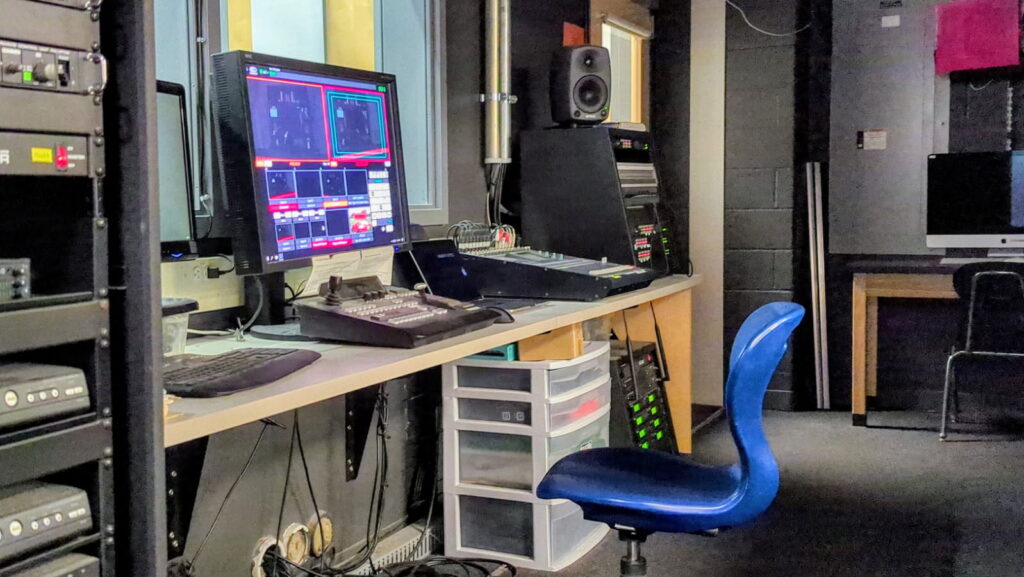
Levi Rosenberg-Van Gameren, a Newton North senior, is enrolled in CTE’s TV Media Arts program. He produces “Update Express,” the social media edition of a student-run show called “Update.” Rosenberg-Van Gameren said he joined the program “just for fun.” His ambitions lie in becoming a pilot.
Wyatt Nelsen, a junior, said he enrolled in the TV program because it is aligned with his career plans.
For students who pursue higher education, the CTE program gives them the hands-on experience that many universities look for, Duff said.
Drafting students can use the CTE projects in their portfolios for college applications. Since the software used has to match industry standards, the technical skills also stand out on their resumes.
Students in most programs work on real-world assignments. Students in the automotive shop do work ranging from oil changes to rebuilding engines. Students in the graphic communications program work with external clients, creating designs for the city’s public events and printing merch for the school’s sports teams.
“In some schools, people might be like, ‘Oh, those are the shops, right?’” Winston said. “They think of it as a second-class thing.”
At Newton North, the CTE programs are prominent, right on the first floor.
“CTE is a really essential part of what makes Newton North, Newton North,” Winston said.
****
This story is part of a partnership between the Newton Beacon and the Boston University Department of Journalism’s Newsroom Initiative.