


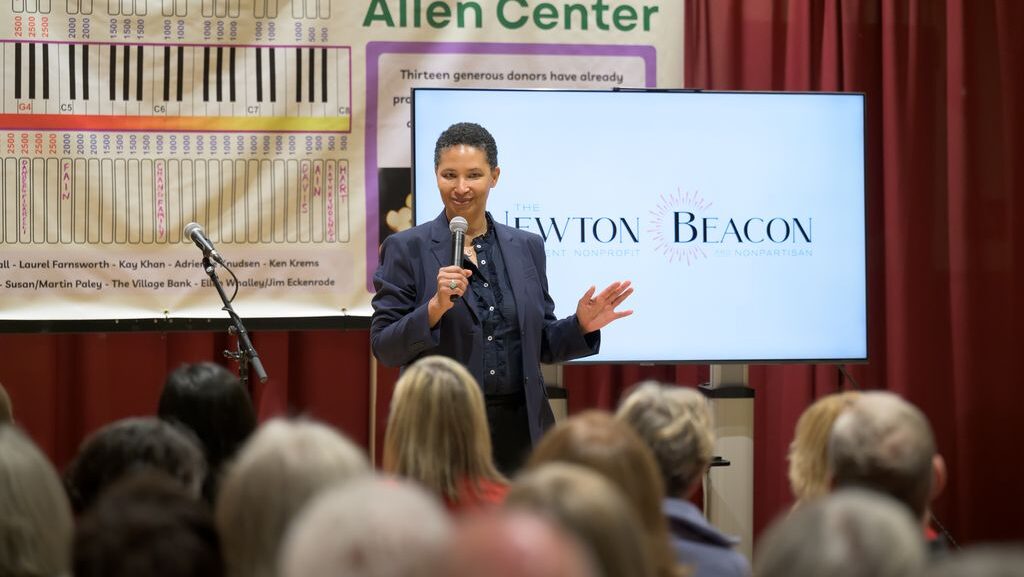
A Harvard professor told a Newton crowd Thursday they have the power to restore an “ailing democracy.”
Political philosophy professor Danielle Allen – who described herself as “mono-maniacally obsessed with healthy democracy” – proposed concrete ways for Newton residents to bolster democratic principles, an especially relevant topic given the upcoming midterm elections.
In April, the Pew Research Center reported that different indicators show a general decline in the health of America’s democracy, and Georgetown University released a poll that reveals 81% of voters believe democracy is threatened.
Speaking to a crowd of dozens in the Allen Center, Allen proposed that two of the main strategies to address this “ailing democracy” are fighting corruption with transparency and widening suffrage.
Davut Habip, a Newton resident who attended the talk, said he agrees. Habip compared the importance of civic engagement with the K12 students in the robotics events he hosted when he lived in Turkey.
“I’ve seen the power of engagement in children,” Habip said. “It’s very important for a democracy and a better future.”
In 2018, Massachusetts became the first state to make it mandatory for eighth-grade students to receive civics education. Allen applauded the mandate. She listed civic education as one of the main ways to promote democracy, as well as enacting electoral reforms and ensuring professional high-quality local, state and national news organizations.
Allen advocated for journalism to improve transparency. The discussion caught the attention of student journalists from Newton North and South high schools, who got to question Allen during the talk—an experience Allen described as a “dissertation defense.”
Grace Yang, a senior in Newton South High School and co-editor of the school’s paper, The Lion’s Roar, agreed with Allen’s point that journalism is a vital part of democracy.
“I try to encourage as many people as possible at my school to write a single article or be open to being interviewed,” Yang said. “I think having everyone be involved to some extent in the journalistic process is really important to setting them up for feeling comfortable to participate in the Democratic process.”
Bethesda Yeh, senior in Newton South High School and co-editor of the school’s paper, said she appreciated how the event promoted journalism.
“As student journalists at Newton South,” Yeh said, “having professional organizations cover what’s happening alongside our work as student journalists is really important and it bolsters the journalistic environment in the local community, which is more important now than ever.”
Yang and Yeh said they feel misinformation impacting their generation. Yang said she tries to combat this by reminding her 18-year-old friends to “use their vote.”

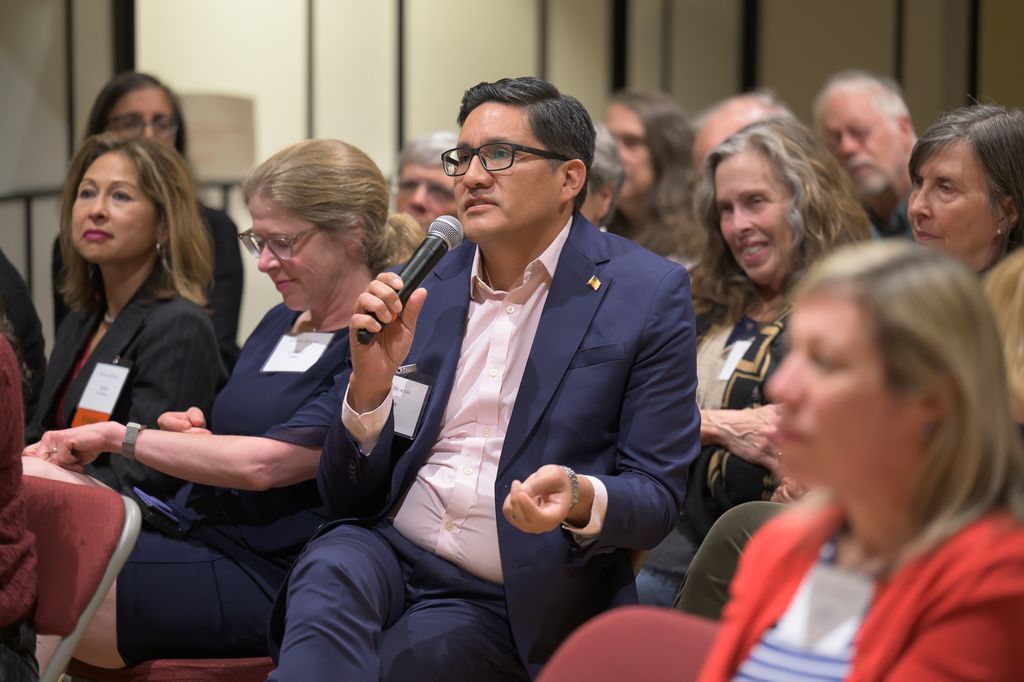
Newton Centre resident Enrique Rosero asks a question during The Newton Beacon’s event, “Democracy, if we can Keep It: A Conversation with Danielle Allen” on Oct. 8, 2026, at the Allen Center in West Newton. Photo by Stevo Rood/ARoodPhoto
Isaac Fine, former board member at the Newton Beacon, which hosted Allen’s talk, said he worries about where his three kids get their news from.
“I know they get news and they stay up with current events,” Fine said. “I don’t know the sources of it, though.”
A 2025 study revealed that over half of U.S. adults say they sometimes get news from social media.
“One of the reasons why I got involved in the Beacon,” Fine said, “was because I felt like it was really important to have professionally reported independent news as opposed to unedited, nonprofessionals posting stuff online, where it’s unclear what their sources are or what their expertise is.”
Asked about how to foster civic engagement, Allen said the solution is encouraging communication and embracing disagreement.
Newton Beacon editor Bryan McGonigle asked how civic engagement can be promoted in a city that remains a home for some people only in the short-term, especially for younger people who can’t afford the rent.
“Housing is a democracy issue,” Allen said.
Reforming the electoral college, improving housing affordability and shifting journalism to a nonprofit model are just a few of the ideas Newton residents shared and discussed during the event.
Asked about his most interesting takeaway from the discussion, Habip said, “I noticed the importance of the word ‘agency.’ When people are engaged, they immediately feel they have agency, meaning they are able to contribute, build the future, not just be subject to it.”
****
This story is part of a partnership between the Newton Beacon and the Boston University Department of Journalism’s Newsroom program.