


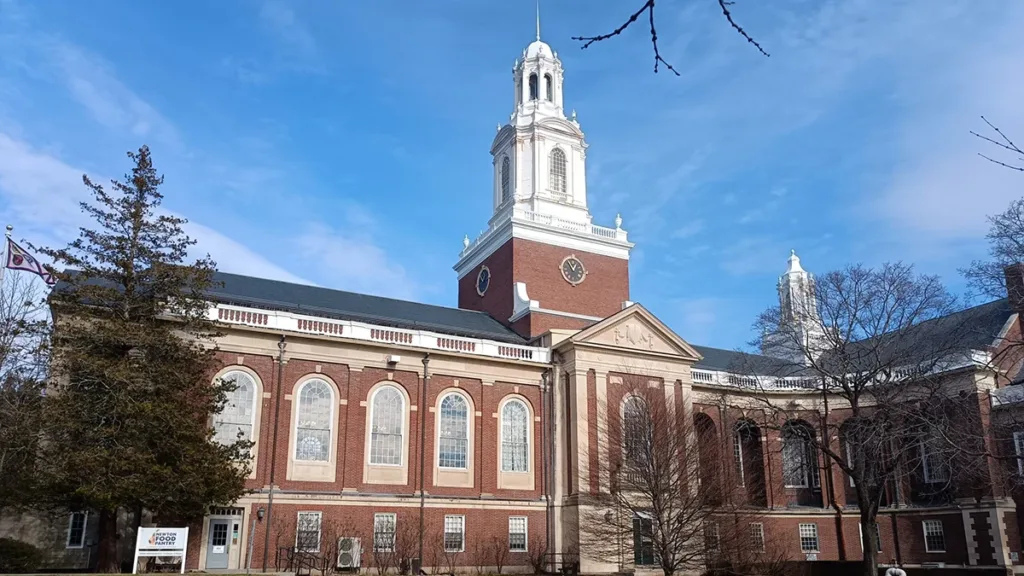
The city council’s Finance Committee voted 7 to 1 on Monday to keep the tax classification—a formula by which the city levies its taxes when it comes to residential and commercial share of the overall tax levy—the same as it’s been for the past few years.
Chief Financial Officer Maureen Lemieux and Assessor Jim Shaughnessy met with the Finance Committee and recommended the city keep the tax classification shift at 175% for commercial properties, which means that, collectively, commercial properties pay 175% of their share so residential properties can pay less than theirs.
The bottom line
This means a 5.27% increase in the commercial tax rate, a 4.55% tax rate increase for single-family homes, and a 4.03% increase for multi-families.
That amounts to a residential tax rate of $9.78 per $1,000 of assessed value and a commercial tax rate of $18.22 per $1,000 of assessed value.
This dynamic can fluctuate. Last year, the city’s commercial property tax saw an increase of just 1.22% while residential property taxes increased more than 4.2%. And in Fiscal Year 2024, the commercial properties saw a decrease in their tax rate, while the residential properties saw an increase.
The Prop 2 1/2 factor
Proposition 2 ½ is a state law that prohibits a city or town from levying an overall tax burden on the community that is more than 2.5 percent higher than the overall tax levy of the previous year.
This doesn’t mean your property tax bill can’t go up by more than 2.5%. It just means the combination of everyone’s taxes can’t go up by more than 2.5% over the previous year. And new growth and debt-excluded projects are exempt from Proposition 2 ½ so new growth is crucial to keep services level in both City Hall and Newton Public Schools.
The tax levy limit for Fiscal Year 2027, Lemieux said, is $480,655,761.
“We cannot go $1 above that, so that number is absolutely key,” Lemieux stressed.
That $480 million is only possible with exemptions for new growth and debt exclusions. The actual increase is 4.38%, not 2.5%.
Residential properties account for between 80 and 85% of new growth, Shaughnessy said.
Homes are hot
The tax classification shifting a bigger burden on commercial properties comes after years of ballooning home values. So without the classification shift, homeowners would pay more than they already do.
“Residential properties have, over the past several years, been increasing at a faster rate than commercial properties,” Lemieux explained. “What does that do? Even without us having this hearing, it creates a bit of a shift of tax burden from commercial properties to residential properties because it is a zero-sum game.”
There’s also the excess levy capacity to factor in. That’s the difference between how much the city actually levies and how much it can legally levy. In models with less of a burden on commercial properties, that number is bigger.
“If we were to use the tax rates that go along with the 175% reclassification, we would only be leaving $18,000 on the table,” Lemieux said. “That’s incredibly important. If we pick 174 or 173%, we would be leaving approximately $200,000 uncollected based on the way that we would be setting the tax rate.”
The formula is complex but the reason for the constant tax classification burden shift toward commercial properties is simple: Explosive residential property value growth.
Newton’s residential properties make up around 92% of the city’s property tax revenues. Commercial properties make up the other 8 percent.
“If you didn’t know it, Newton is a residential community,” Shaughnessy said.
And prices have soared in recent years. In 2017, the median sale price of a single-family home in Newton was $1.15 million. This year, it’s $1.85 million. That’s a 60% increase in less than a decade.
“So if somebody says, ‘When’s the height of the market?’ It’s 30 seconds ago,” Shaughnessy mused. “It’s still happening now.”