


Residents relaxing on their balconies at Opus Newton in Oak Hill this fall have been startled by large, strikingly patterned insects landing beside them.
Spotted lanternflies, an invasive pest from East Asia, have made themselves at home all over Newton.

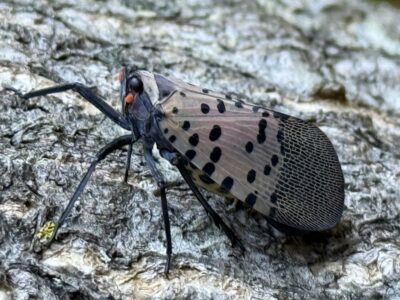
Adult spotted lanternfly. Photo by Richard Primack
For years, we’ve been reading alarming reports from Pennsylvania, where the insect was first found in the United States in 2014, and from other states to our south. There, lanternflies dropped from trees onto picnickers, damaged grapevines, and coated cars and patio furniture with sticky, smelly droppings.
Here in Newton, that all seemed like someone else’s problem. Not anymore.
After two years of scattered sightings in Massachusetts, lanternflies appeared in substantial numbers in Newton this summer and fall, often in dense local infestations.
Residents have logged 67 sightings across the city on the iNaturalist app. Newton will likely see a full-blown outbreak in 2027, affecting our gardens and our time outdoors.
How to recognize them
Adult spotted lanternflies are hard to miss. They are nearly an inch long with grayish-brown forewings with about 20 black spots and a brick-like pattern on the back third. Red hind wings show when the forewings are not fully closed, and the head and long legs are black.

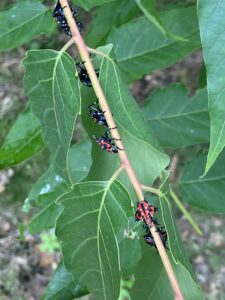
Lanternfly nymphs on tree-of-heaven leaf. Photo by Katherine Howard
Lanternflies aren’t shy. They sit singly or in dense clusters on plants and pay little attention to people. Poke one with a stick, and it simply hops to the ground.
In late summer, females lay eggs on tree trunks, stones and other flat surfaces in masses that look like gray or beige smears of mud. The eggs hatch in spring into small, wingless nymphs that are black with white spots. By summer, the nymphs turn red with black and white spots before becoming adults.
What harm do they do?
First, the reassuring part: lanternflies don’t bite or sting, and they’re harmless to people.

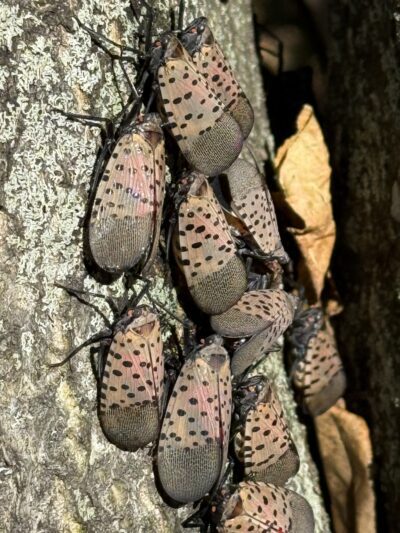
Lanternflies crawling on tree bark. Photo by Richard Primack
Plants are another matter. Lanternflies pierce bark and stems with a needle-like mouthpart to feed on sugary sap. The wounds keep oozing afterward, attracting flies, yellowjackets and even honeybees.
The insects also excrete large amounts of sweet, sticky liquid called honeydew that coats decks, cars, and outdoor furniture. On leaves, it grows a black sooty mold that blocks the sunlight plants need.
Their favorite food is tree-of-heaven, itself an invasive species, recognizable by its large compound leaves, thick twigs and pale bark that resembles cantaloupe rind. Almost every mature tree-of-heaven I’ve checked around Newton has lanternflies on it. They also feed on maples, grapevines, apple trees and many other plants, including crops such as soybeans.
The good news, according to Newton Parks and Recreation Commissioner Marc Welch, is that lanternflies generally do not kill or seriously damage healthy established trees in Newton’s yards and parks.
They are a greater threat to vineyards and orchards. But on trees already weakened by other stresses, heavy infestations can cause leaves to wilt and may further damage the tree.
What can Newton residents do?
Lanternflies are already all over Newton, so the goal now is to protect your own plants and avoid giving the insects a ride somewhere new, especially farther north. Before a trip out of town, check your car for hitchhikers, and don’t move firewood or plants that could be carrying eggs or nymphs.
Now is a good time to go egg hunting, if you have a sharp eye for the egg masses. State agricultural officials recommend scraping off and destroying any egg masses you can reach on trees, fences, and outdoor furniture.
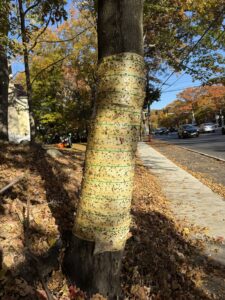
Tree-of-heaven wrapped in sticky tape. Photo by Richard Primack
In spring and summer, you may want to crush any nymphs and adults you find in your garden, especially on maples, tree-of-heaven, and grapevines, although it’s unclear how much impact this will have. My Newton Centre neighbor checks her grapevine every morning, and there are always new lanternflies to step on.
Some tactics do more harm than good. With the insects this widespread, spraying insecticide is unlikely to help and can kill beneficial insects.
One Beacon Street homeowner wrapped a tree-of-heaven in sticky tape. It caught a few lanternflies, but also hundreds of harmless bees, flies and moths. Lampshade traps that wrap around the tree trunk may be a better approach during the egg-laying season.
A more ambitious step would be to remove Newton’s tree-of-heaven trees, eliminating both the pest’s preferred host and an invasive plant. Scientists are also testing parasitic wasps from China as biological controls, but that help is likely years away.
For now, learn to recognize this pest, and get out your stomping shoes.
Richard Primack is a life-long Newton native and a Professor of Plant Ecology at Boston University. He can be reached at primack@bu.edu.