


Dissatisfaction with the garden at her new home turned Deborah Chud into a gardener. She took inspiration from the gardens of what has been called the new perennial movement or the new naturalism and, over 10 years, single-handedly replaced the existing garden with the serene naturalistic landscape that surrounds her home today.
The movement toward naturalism in gardens began over 40 years ago. Among the goals of naturalistic design is to include plants suited to the ecology of the garden site and in combinations inspired by nature. One of the best-known designers of naturalistic landscapes is Dutch designer Piet Oudolf, whose work includes the gardens of the High Line in New York City.
Chud came to gardening after retiring from a career as a non-clinical psychiatrist and Tufts Medical School instructor and downsizing to a new home on the Chestnut Hill street where she and her husband had raised their family.
Following removal of invasive, weedy and overgrown plants at the new home, Chud sought a design inspired by nature for the yard. However, the garden that was designed for and installed at her new home didn’t reflect the aesthetic she wanted. The garden instead contained rote repeating patterns of traditional garden plants and shrubs that, to her, felt static and out of sync with one another, with a too-bright and clashing color palette. While the garden included the prairie grasses that Chud had requested, they were planted in stiff and unnatural lines.

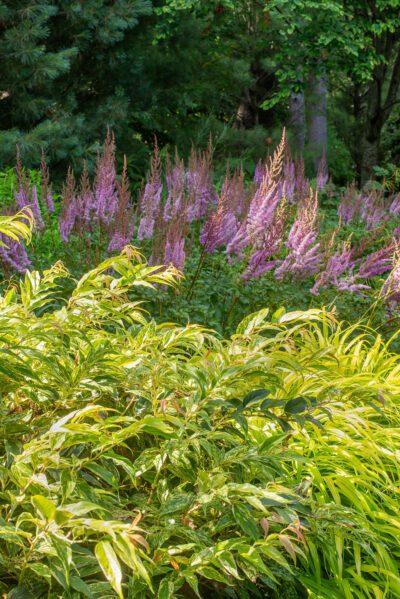
Tall pink astilbe and native leucothoe sway in the breeze in Deborah Chud’s garden. Photo by Jordan VS Photography
Chud explains that plants in a naturalistic garden have a lower flower-to-foliage ratio, often with smaller flowers than many traditional garden plants. While the new garden contained some such plants, there were too few to make an impact. She describes the naturalistic garden as having a delicacy of plant structure that “enables certain plants to move in a breeze and catch light” and a delicacy of color palette. Traditional plants, such as hydrangeas, roses and azaleas, don’t fit in well within a naturalistic design.
Motivated by a strong desire to change her garden and with no prior knowledge of plants, Chud studied Oudolf’s gardens and planting plans, taking extensive notes of his plant combinations and creating a large database of possibilities for her own garden.
She removed most of the plants in her garden, leaving only some grasses, native Leucothoe shrubs, and a lush section of native Pennsylvania sedge (Carex pensylvanica), and started over. Working on one to two beds per season, she replanted in the style she wanted, learning as she went along. She describes her early efforts as not designing per se but planting in imitation of Oudolf’s plant juxtapositions, picking and choosing from his combinations, but without copying a single specific Oudolf garden in her own yard.
Pickaxe in hand to break through the clay soil in her garden, Chud replaced the soil to meet the needs of the new plants, sometimes mixing it with the original clay for moisture retention or adding compost to enrich the soil. On her own, she planted each of the 3,000 plants in her 4,200 square-foot garden, which is encircled by a rabbit-proof fence. The resulting tranquil garden vibrates with pollinators and attracts birds.
Like Oudolf, she uses a mix of native and non-native perennials in her design and will choose a native plant where it can provide the same aesthetic effect as a non-native one. She says that she learned “the hard way” that some native plants self-seed around the garden, and she removed the most aggressive self-seeders. Chud also notes that, since different perennials have different life spans, she selects long-lived perennials for her garden instead of plants that will live only two or three years.

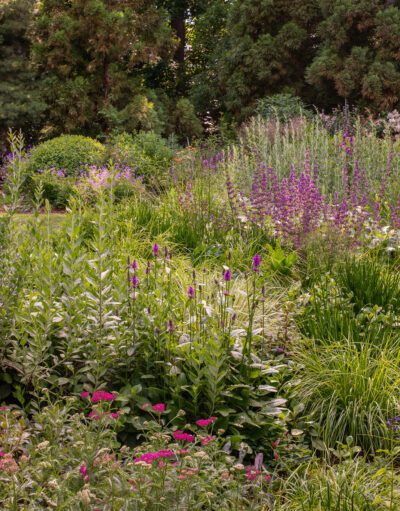
Deborah Chud combines plants in her garden with an eye to their different shapes and in colors that are related. Photo by Jordan VS Photography
Chud combines plants with an eye to a plant’s form and, secondarily, to color. She describes the three basic plant shapes as round, vertical and umbel, or umbrella-shaped. The umbel, she says, is an in-between shape that combines well with round and vertical shapes.
According to Chud, the most successful plant combinations result where either the plants’ structure or color is related. For example, a sweep of deep purple-pink vertical Astilbe ‘Purple Lance’ is harmoniously planted near a lighter pink round Astrantia major ‘Roma’ in a shady section of Chud’s garden. The nearby round red Monarda didyma combines well with both plants since red is related to purple and pink. While the Astilbe would also pair well with a different-colored vertical plant, Chud explains that she doesn’t like stark contrasts in the garden and wouldn’t place the saturated color of the Astilbe next to a vertical white plant, regardless of plant combination guidelines.
Chud includes what she calls “theme plants” in a few places in the garden, including the purple-pink Astilbe and pink Astrantia, noting that “the repetition makes the garden coherent.” Employing a strategy used in naturalistic gardens to provide continuity, she also includes “scatter plants” to “tie beds together that have otherwise very different palettes.” Her favorite scatter plant is Allium sphaerocephalon, or drumstick allium. While there are occasional repetitions of plants and colors, the garden doesn’t have a specific color scheme.
While most of Chud’s garden is mature, she has recently experimented with matrix plantings on a sunny slope. Generally, a matrix is a mass planting of one or a small number of plant species of a subdued look, like grasses, with other, visually stronger plant species mixed in. In Chud’s garden, the plantings mimic a meadow, with individual Echinacea plants rising out of a matrix of short, round and tiny-flowered Calamintha, and individual Sedum and Stachys plants intermingled within a matrix of autumn moor grass (Sesleria autumnalis).
Chud’s garden is low maintenance. As in nature, the garden doesn’t require deadheading. Her plants grow close together, leaving no bare space in the beds for weeds to take hold; any weeds appear only on the peripheries. She uses her irrigation system minimally to supply water to the least thirsty plants and hand-waters those that show they need it. She hires a crew to cut the garden back in spring and add nine yards of leaf mulch to the beds.
Of her garden and her work designing it, Chud says, “This is where I feel I belong.” That sentiment and the success of her own garden have led Chud to a second career designing gardens and giving presentations to garden clubs and other groups. For information about her design and education services and to see more photographs of her garden, visit her website, Not Your Mother’s Garden.
Lisa Gianelly and Marian Prokop, who alternate columns, are Newton residents and certified master gardeners. They welcome your suggestions for column ideas and news to share of gardening-related events throughout the city. They can be reached at beacongardeners@gmail.com.