



One recent Saturday, my wife and I jumped on our bikes and went to the bakery. Except this one was at the end of a driveway on Fairway Drive.
Vittoria Vanni opens Gingerbread in Love most Saturdays when she and her husband roll out a big white cart and sell amazing cookies, brownies, scones, and other goodies to anyone who walks by.

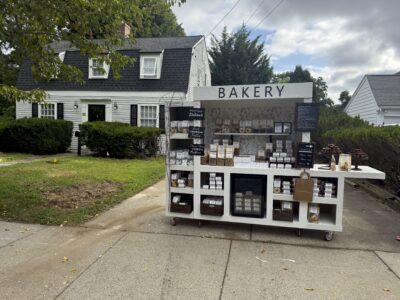
Front-yard bakery Gingerbread in Love on Fairway Drive. Photo by Chuck Tanowitz
She’s part of a growing list of small bakeries and other front-yard retail outlets around the country operating out of people’s homes. Some are just carts, but many others have some level of permanence, whether it’s a garage acting as a retail location or a simple shed operating on an honor system. In fact, the Boston Globe recently touted this in an article listing the area’s best cottage bakeries.
Newton’s villages act as our biggest retail assets, and for good reason. They’re walkable with small shops and offer great access to the surrounding neighborhoods. The villages emerged over time, often helped by a nearby train station, as people congregated in places they passed and used in their daily lives.
As the car took over Newton through the second half of the 20th century, our housing stock became more diffuse, and while those walkable villages are great for people who live right there, for many in more suburban-like environments, getting to retail means first getting in your car.
But today, more of us work from home at least part of the week, so having retail closer to where we are just makes sense.
The answer could lie in what are officially called Accessory Commercial Units (ACUs). We used to allow this kind of development here in Newton, and some of our most beloved places fit this mold. Adams Street is filled with great examples, which is one reason it’s such a great place to walk, like DePasquale’s sub shop and its neighbor Dolce Vita Salon. It’s not just Adams, but also places like Pizza Market in West Newton.
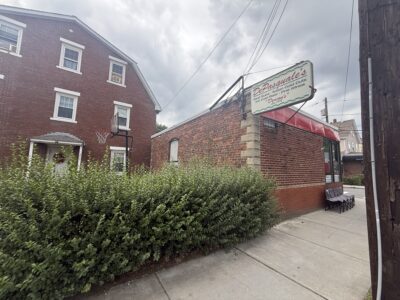
DePasquale’s sub shop in Nonantum. Photo by Chuck Tanowitz
Broadly, the US used to build these kinds of things all the time, but we stopped when our zoning codes separated commercial and residential uses. Now cities like Austin, Texas; Portland, Oregon; New Orleans; Raleigh, North Carolina; and Minneapolis are all moving to legalize the concept once again and revive walkability in residential neighborhoods.
These spaces offer a lower-cost alternative for businesses that struggle to get off the ground. Newton has a lot of new retail spaces coming on the market in the coming months, but new construction often comes with higher rents and longer-term leases. Allowing front-yard retail could help Newton meet its growth needs in village centers while still letting smaller businesses stay local.
Allison Yee, founder of UpNext, which operates out of a small storefront on Adams Street, helps small retailers get off the ground by working with property owners to create rotating retail. One current program with The Village Bank will bring this concept to Newtonville. The goal of all UpNext’s incubator spaces is to give founders the support and space to grow and explore where their next opportunity could take them. That next step is where retailers often run into a challenge.
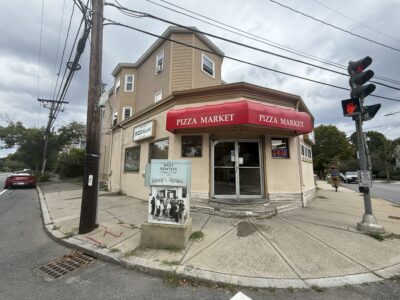
Pizza Market in West Newton. Photo by Chuck Tanowitz
“There is not a lot in the middle,” she said, noting that retail rents are high here. “Many of the spaces are not as accessible in Newton as in other communities.”
The American Conservative calls ACUs the “retail missing middle,” offering a way for startup retailers to gain a foothold without a massive up-front investment.
In Public Square, Planning and real estate professional Garlynn Woodwong writes: “Accessory commercial spaces (ACUs) thus represent an opportunity to create affordable commercial spaces, without subsidy, without large government programs, without complicated financial maneuverings or risky leveraging tools. All that is required is to change zoning codes to legally allow for the concept of accessory commercial space.”
He goes on to point out how major brands like Hewlett Packard, Google, Apple, Microsoft, Amazon, and Disney all had origins in a garage. Needham’s TripAdvisor has a similar story, but it involves a small office above a pizza place.
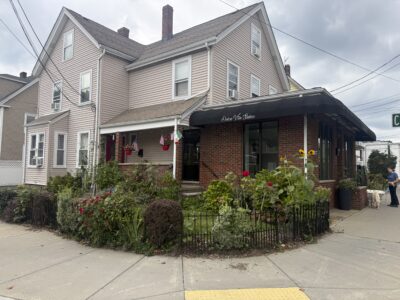
Dolce Vita Salon on Adams Street. Photo by Chuck Tanowtiz
To accomplish this, we would need to update our zoning code. Given that Newton just had to add “Raised Garden Beds” to the code to allow people to build planters, it’s clear that front yard retail would take work by the City Council. It would also give people a chance to voice concerns and learn how other communities dealt with those issues.
Joel Kamm specializes in small-footprint retail projects and operates his company, Flexetail, from a custom shed in his Newton backyard. He told me he walks away from any project that requires a special permit because the process isn’t worth the time and risk. He calls front-yard retail the modern version of the lemonade stand and notes that not every location is right for this kind of thing, with some offering better foot traffic than others.

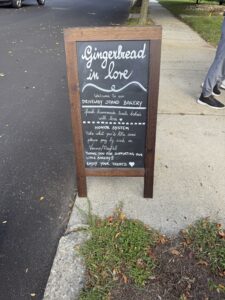
The sign for Gingerbread in Love. Photo by Chuck Tanowitz
For Gingerbread in Love, the cart is a launchpad, but it has drawbacks. First, it’s temporary and needs to be set up, so it can’t be a permanent business. This lack of permanence also means that extreme weather can prevent even having her business out there at all.
Unfortunately, she will need to move because her lease is up. I’m sure the business will move with her so she can keep growing. In her Instagram post announcing the news, Vanni said that she hopes to find another driveway so that she “can continue doing exactly what I love: filling this tiny bakery with cookies, pies and all the things I bake during the week, and opening it for you on Saturdays.”
As she grows, a permanent structure, even a small shed, could turn this from an ad-hoc business into something more consistent.
Solutions like this offer a creative way to encourage new businesses, make our neighborhoods more walkable, and even bring people together. Just head over to Fairway Drive to buy some wonderful scones and cookies, and see what conversations develop.
Chuck Tanowitz is a Newton resident who has been involved in local economic development for more than a decade. He can be reached at chucktanowitz@gmail.com.