


It’s almost lunch time at the Tiger’s Loft Bistro in Newton North High School and students in the kitchen are readying for the rush.
One student spreads Russian dressing on slices of marble rye bread to assemble Reuben sandwiches. Another places brownies in plastic containers. All wear caps and black aprons with name tags clipped to the front.

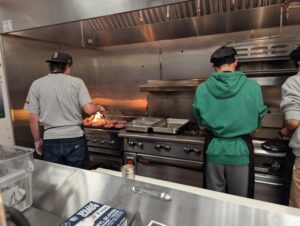
Newton North culinary students at stove. Photo by Clara Silverstein
“Burger time!” someone shouts.
Chef and culinary instructor Chris DeRocher glances towards a boy making hamburger patties and asks, “Are you sure these are four ounces? I need you to weigh out those portions.”
In a corner of the kitchen, two students fire up the stove to begin grilling as Mike Rostafin, another chef and culinary instructor, supervises. Orders from Tiger’s Loft customers, who are Newton North staff and students, start coming in via an electronic system run by Toast.
“Hot coming over! Hot!” shouts Chef Chris as he carries a metal tray of hot rolls through the kitchen.
By the end of lunch on a busy Friday, 300 customers will be served, all within one hour and 15 minutes.

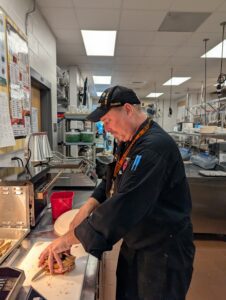
Chef Chris DeRocher at work. Photo by Clara Silverstein
The brisk pace at the Tiger’s Loft helps students in the culinary education program at Newton North learn how to work in food service. Anyone can take one culinary course as an elective, and there are about 128 exploratory students per year, according to Kathleen Duff, director of Career & Technical Education at Newton Public Schools.
About 65 upper classmen decide to focus on culinary education, with about 10 seniors graduating each year.
In a community like Newton, where college prep is paramount, culinary arts students may feel like they are bucking the trend. But the well-structured program gives them a practical alternative to academics.
“Everybody loves food,” Duff said, adding that many students discover a passion for culinary education by taking one class as an elective. Many graduates also go on to college, especially to schools that offer culinary degrees, such as Johnson & Wales in Providence.
Ethan Van Buskirk, a senior serving burgers at the Tiger’s Loft, said he opted for the culinary arts major because it aligns with his interests.
“I don’t do sports or play an instrument,” he said. “Cooking is something I can do and enjoy.”

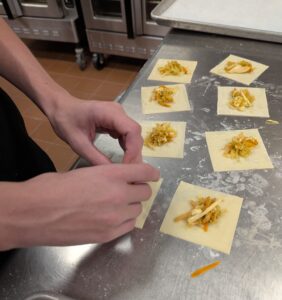
Culinary students making dumplings. Photo by Clara Silverstein
Newton North students who select the culinary arts major will spend more than 900 hours in the program by the time they graduate. Much of their training takes place in a kitchen with professional equipment that meets industry standards.
Students become certified in food safety handling and allergy awareness before they can start cooking. They also have to rotate through all food service-related jobs, from ordering food to washing dishes.
At the Tiger’s Loft, students cook as well as take orders from customers, manage the cash register, and count money. The restaurant is open for breakfast and lunch. The menu is usually a choice of four sandwiches and sides, hot and cold beverages, and weekly specials.
In the dining room, Lisa Marzilli, who has been part of the program for 30 years, helps students set up, keep up with orders, and clean up afterwards. A sign above the case where salads and desserts are stored reads “Marzilli’s Paradise in Italy.”
Serving lunch at the Tiger’s Loft comes “as close to the industry as we can make it,” Chef Chris says. “The students see the crowds coming in. The pace is what it’s really like in a restaurant. You can’t replicate that in the classroom.”



Measuring cups in the Tiger’s Loft kitchen. Photo by Clara Silverstein
After lunch service ends, some of the students sit down before cleaning up. They good-naturedly grouse about having to wash dishes and the “boring” safety training classes. Yet each one also points out something they enjoyed learning to make, from apple turnovers to homemade cookie dough.
“I didn’t expect the food to be this good!” one student said.
Chef Mike worked in fine-dining restaurants before coming to Newton North so he said he tries to give students the training that he wished he had received.
“When I was a young cook, I didn’t know the business end,” he said, adding that he likes to “slow down” and explain things that may go by the wayside in a busy professional kitchen. “If they make a sauce, I explain what it does,” he said.
The Career & Technical Education program in the Newton Public Schools offers a variety of majors, including automotive, graphics, early education, and TV-media arts.
At one time Newton had a separate Technical High School, which opened in 1907 across the street from the main high school. Technical and vocational classes became part of the regular high school after World War II.
Chef Chris said the culinary program tries to teach more than food prep so students will be prepared for whatever their future brings.
“It does not matter if a student does not go into the culinary field,” he said. “We teach and have the same expectations as any employer. It is important to show up on time, show up ready for work, work together as a team, and respect each other.”
Clara Silverstein is a cookbook author with extensive knowledge of Newton history. She can be reached at clara@clarasilverstein.com.