


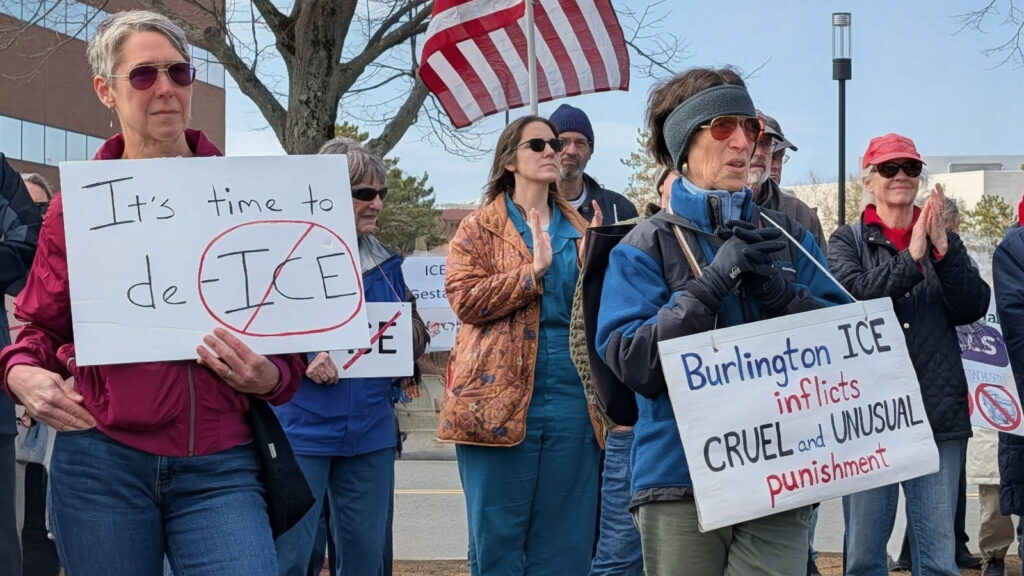
As Immigration & Customs Enforcement raids continue in communities across America, Newton’s city website has added a page dedicated to informing immigrants and their allies about their rights.
Newton has had a Welcoming City ordinance since 2017, which is basically akin to a sanctuary city status, meaning city employees are not allowed to help federal immigration officials track down people in the city or carry out any other immigration enforcement activities (there are exceptions for when a suspect has other criminal charges and could be a danger to the city). Mayor Marc Laredo signed an executive order in February declaring that ICE isn’t allowed to use city property for its activities.
And Gov. Maura Healey has signed an executive order barring ICE from using state property for its activities.
The City Council has been discussing with the Laredo administration ways the city can mitigate the sense of panic throughout the villages when it comes to ICE activity and protect the city’s immigrants from that activity. So far, that has resulted in a new page on the city’s website dedicated to immigrant rights.
The page has several drop-down tabs with questions and answers about immigration law and ICE policies. It also has a bunch of links to statutes, immigrant rights groups and more.
The new web page is only the start of the city’s policy discussion regarding federal immigration in this welcoming city, which is a conversation that’s ongoing, complex and—according to immigrant rights activists and several city councilors—urgent.
“This, of course, is a complex situation nationally, statewide and locally,” Newton Chief Operating Officer Josh Morse said to the council’s Public Safety and Transportation Committee last week.
That, Morse added, means new questions and answers arise frequently and bring even more considerations to the ongoing conversation with every new development locally, nationally or otherwise. Even a Supreme Court ruling could upend Newton’s discussion at any time.
So, Morse explained, the information on the new web page is what is current and up-to-date at any moment, but anything can change at the drop of a hat.
The council held a meeting with Police Chief Tim Cohoon regarding city policy followed by a public hearing in April about those policies and other ideas to navigate immigration rights as a welcoming city in the age of Trump 2.0.
“In response to the City Council’s recent inquiries, we have developed responses and aggregated appropriate helpful resources to share with the community,” Morse continued.
In addition to the new web page, Morse said, the administration is providing staff with ongoing training, and the administration is working with Chief Cohoon to implement a pilot program for police body cameras, to be fully operational within a few weeks.
“This is an unprecedented and fluid national landscape, and our preparation and response must remain equally adaptive,” Morse said.
The Trump administration has been adapting its strategies as well.
Trump’s “border tzar,” Tom Holman, as Councilor Maria Greenberg noted, recently said the administration is going to “turn up the heat” and has “more work to do.”
“The scale of enforcement has escalated rapidly,” Greenberg lamented. “ICE arrests surged to 10,000 people in a single five-day period this month. Tragically, two innocent men were killed this month as a result of poorly trained and inadequately vetted ICE agents. Understandably, the public has profound fear and anxiety for the safety of our families and neighbors.”
Greenberg suggested creating pamphlets and adding signs around the city stating that city staff are not allowed to work with ICE on immigration enforcement. In addition, Cohoon assured the council that police are not helping ICE with civil immigration matters, and police may step in to stop what they deem as “excessive force” by ICE agents toward civilians.
“We are not authorized to assist in civil immigration in any way, shape, or form, and nor do we,” Cohoon said.
“It’s very narrowly defined and fact-specific,” Cohoon said. “We can’t put our officers in a position that they are going to intervene with lawful federal authorities, and that’s what I want to create the expectation for. So all of these things need to be true in order for them to intervene. Now, that doesn’t mean we can’t have an approach in any instance on keeping the peace and de-escalation, and trying to assist and maybe take the tenor down a little bit if officers were to show up at a scene that was unfolding and moving out of control.”
Councilor Susan Albright said she spoke with representatives from the ACLU who gave her recommendations for improving the city’s ordinance.
One suggestion was to remove the part of the ordinance that provides an exception for terrorism. Immigrant rights advocates have said “terrorism” language can make an ordinance meaningless, since “ties to terrorism” can be a subjective concept.
The state legislature is currently debating the Protect Act, which would enhance the state’s protections for immigrants and its refusal to help ICE operate in Massachusetts.
Albright also asked Cohoon if there’s a way to tell if a police officer violates the ordinance and reports a suspect’s immigrant status to ICE, citing an instance last week in which an arrest was made and an officer was believed to have tipped off ICE, according to a local immigrant rights organization.
Cohoon said he would look into that and would share his findings publicly.
The chief brought up another incident from July in which a motor vehicle stop resulted in a vehicle being towed and then an arrest by ICE agents when the defendant went to pick up his car.
“That officer had suspicion that the motor vehicle documents that were presented to him were fraudulent. It turned out they were, which is a felony,” Cohoon said. “That person ultimately came to retrieve the motor vehicle and the person was arrested on state charges on forging motor vehicle documents, which again is a felony. That person was booked into our facility on the felony charges and processed in the manner that was required, and ultimately I believe ICE notified the police department there was a detainer.”
Newton police told ICE they don’t honor ICE detainers.
“And my understanding is the person was bailed from our facility and picked up on the street by ICE,” he said.
These conversations highlight just how complicated law enforcement can be when a local government and state or federal government are diametrically opposed and that opposition is enshrined in law and local ordinance.
For Cohoon clarity is key.
“I’ve seen other city and municipal police officers respond across the country where there wasn’t a whole lot they could do to improve the situation. And that’s extraordinarily frustrating, particularly to the helpers. I wish we had more clear and better direction or even more clear and better coordination. I don’t mean working with folks in civil immigration but I mean just better communication throughout.”