
HealyPriest
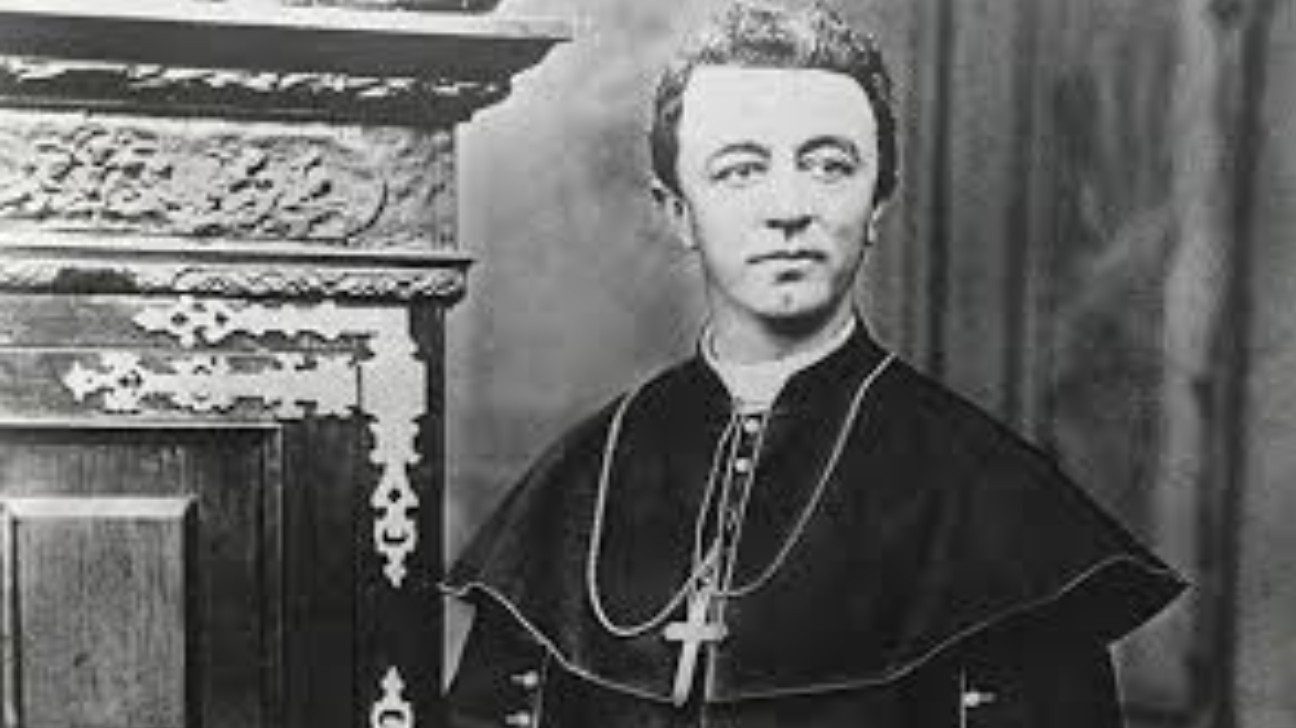
James Augustine Healy was a mixed-race Catholic priest who moved his family from Georgia to New England. Public domain image
James Augustine Healy was a respected priest in the Archdiocese of Boston in the 1850s and 1860s who served as the diocesan chancellor. He had been born in Macon, Ga., but his Irish immigrant father had sent him north for an education to escape the vicissitudes of Southern prejudice.
His father, a wealthy planter, died in 1850. The sale of his father’s estate, including dozens of slaves, allowed Healy to purchase a home on Waltham Street in Newton. It would give Healy a place to retreat from work, as well as provide a home for his many orphaned younger siblings.
Several of those siblings would also go on to illustrious careers in the church, another was an officer in the U.S. Revenue Cutter Service, and another would become a respected Newton matron.
But the Healy siblings had a secret. They had been born slaves.
Michael Healy had come to the United States in the early 19th century for the same reason as many young Irishmen: to seek his fortune. This was before the Irish Famine, but conditions were still more favorable in America than at home. In Ireland, the British state had taken the land away from the indigenous inhabitants to enrich themselves. In America, the settlers had done the same thing. The state of Georgia had large quantities of land that had been taken from the Cherokee and Creek tribes, and it was allotted to white settlers by lottery.
Michael Healy was lucky and received good plots. He quickly grew prosperous off of successful cotton cultivation, which allowed him to purchase numerous slaves. Healy would have been a desirable match for the daughter of a fellow planter. But he was not interested in marrying one, because he had a committed relationship: with Eliza Clark, a woman that he owned. They would have 10 children, nine of whom survived to adulthood. James was the oldest.
It’s likely that Eliza was, herself, mixed-race. Ellen Craft, the extremely light-skinned black woman from Macon who fled to Boston disguised as a white man, claimed the Healys were her cousins, and recent DNA testing has confirmed this is true.
Interracial marriage was not legal in Georgia. It was, however, common for male slave owners to sexually assault their female slaves. The ‘children of the plantation’ inherited their mother’s status as enslaved, a legal doctrine known as partus sequitur ventrem. For the plantation owner who had a legal white wife and white children, this was ideal. He did not have to deal with the consequences of his behavior and, in fact, profited from it. But Michael Healy did not have a legal white wife. He had his ‘trusty woman,’ Eliza. His mixed-race children were his family, and like any wealthy father, he wanted to provide them with the best education he could afford.
But his children were slaves, and there was nothing he could do about it. In Georgia, a slave owner could not free his slaves, even on his deathbed. And slaves legally could not attend school. His only choice was to send his sons to the north. But this, too, posed a problem: free children of color could not attend most white schools. This led him to sending his eldest sons to a school in New York run by the Quakers, a Protestant denomination that was more supportive of racial integration.
While Healy had probably been baptized Catholic in Ireland, it does not seem that he was particularly religious as an adult. In any case, there were no Catholic churches in rural Georgia even if he had wanted to attend one. But while traveling from DC to New York to visit his sons, he happened to meet John Fitzpatrick, who was returning to Boston after being consecrated as auxiliary bishop of Boston. Fitzpatrick was trying to start up Holy Cross in Worcester as a combined high school-undergraduate college, and he invited the Healy boys to attend.
They did. They were quickly baptized and confirmed as Catholics. They learned how to act in their new role as members of a faith that was assumed to be the domain almost exclusively of white emigrants. James would write in his diary about attending and laughing at a blackface performance. He would never see Georgia again.
But his brother Hugh would. Michael Healy had tried to write a will that would send Eliza and the children to freedom after his death, but this was legally difficult to do. Eliza would die first in 1850, and Michael would follow her shortly after. The remaining children at home were, legally, slaves, and belonged to the estate. Hugh returning to Georgia to retrieve them was dangerous for him: he was also legally a slave. But he was able to bring them north.
The other slaves on the plantation were sold, along with the land itself, leaving a large inheritance for the Healy siblings. They were not supposed to be able to inherit this, but they did.
After finishing at Holy Cross, James wanted to become a priest for the Archdiocese of Boston. But there were some problems. One was that a man had to get permission from the diocese of his birth to be ordained somewhere else—in this case, the bishop of Charleston, South Carolina—which undoubtedly would have led to uncomfortable questions. But Fitzpatrick ignored this and treated James’ baptism in Worcester (then still a part of the archdiocese of Boston) as his ‘spiritual’ birthplace. He would also need special permission because he had been born out of wedlock, since his parents could not legally wed. Fitzpatrick also ignored this.
The primary Catholic seminary in the United States was in Maryland. Fitzpatrick, however, had attended seminary in Montreal, and sent many of his seminarians there. While that meant having to learn French, it had the advantage of being closer. But it had a particular advantage for Healy, who would be legally at risk of being returned to slavery if in Maryland.
He then spent time studying in Paris, where he would be ordained. He was ambivalent about returning to Boston—because he knew that people knew. But he returned and was elevated to chancellor soon after. James O’Toole, in “Passing for White: Race, Religion, and the Healy Family, 1820-1920,” suggests this was in part because Fitzpatrick knew a white priest might be wary about living with a black one. But Healy would become a highly respected priest not only among Boston Catholics but also among Protestants.
His home in Newton was his respite. He sometimes walked the nine miles from the Cathedral of the Holy Cross to Waltham Street. The Healy children rarely mentioned either of their parents, but they were extraordinarily close to each other, and several of the children spent time living in James’ house in Newton. It was a place for sisters Josephine and Eliza to return from their summer breaks from their high school in Montreal. Both would become nuns, and Eliza would become a mother superior. It was also a place for his brother Sherwood to stay when he returned from his studies in Europe—studies he was undertaking because he was more visibly black, and the church higher ups were not sure if he would be accepted as a priest in Boston. James sold the house in 1868, likely as his youngest brother, Eugene, had come of age.
One sister, Martha, would marry an Irish emigrant and return to Newton, living not far from where James’s house had been.
James also entertained other priests in Newton. A priest owning a private home was somewhat unusual. While diocesan priests do not take vows of poverty, they also are not paid high salaries. The sons of Irish emigrants to Boston did not have the plantation wealth James did. But they had something he would never be able to pay for: a totally secure place in society.
One of his frequent guests was Father Hilary Tucker, who was from Missouri and had no local family. He would enjoy fishing trips and carriage races with James and his siblings, although he thought James coddled some of his siblings too much. He wrote in his diary that he always defended Healy from prejudiced remarks from other priests. But he also disdained black troops and mixed-race people he called “mulattoes.”
This was one of the paradoxes of the Healy family. On the one hand, people in Boston knew they were mixed race. At this time, mixed race people were generally treated like they were black, and this was an age when a black Protestant clergyman from Boston was forcibly removed from the captain’s table on board a ship. But Sherwood, who was visibly mixed, became the respected rector of the Cathedral of the Holy Cross. Healy was appointed bishop of Portland, and one priest said no Catholic in Maine would respect a “mulatto” bishop; but in fact this was not the case, and his parentage was otherwise never mentioned. They weren’t white, but they also were. When Augustus Tolton, a visibly black man from Illinois, was ordained in 1886, the Boston Pilot ran a story about the “first colored priest.”
It seems that brothers Patrick and Michael were able to successfully conceal their parentage. Patrick entered the Jesuit order, who declared that Michael and Eliza living together as husband and wife was good enough to consider Patrick their legitimate son. The Jesuits knew and were sometimes personally prejudiced against him, but did not reveal this to anyone else. He would become president of Georgetown University in DC, a cultural world away from Boston and a place where an ‘open secret’ about being black would have ruined his career. The younger Michael entered the U.S. Revenue Cutter Service, a predecessor of the U.S. Coast Guard. Black men could serve in this, but not as officers, a commission he received in part because of letters written by his brothers’ high-up friends. When Patrick accompanied Michael on a trip to Alaska, he wrote about pitying the ‘half-breeds’—that is, the children of a white and Inuit couple.
When the Healys died, all of them were listed as white. The last to die was Martha in 1920, who had been living with her daughter Agnes in Watertown after her husband had died in 1908. But that was not the end of the story. In 1951, one of Martha’s other daughters, Bessie, received a letter she did not want. She was 73 years old and had spent her life as white, marrying a fellow Irish American at Our Lady’s in 1908. She begged the letter writer, a Jesuit historian, to let the past be the past. But Albert Foley, who would become a white ally to the Civil Rights struggle, would go on to publish several books about the Healys. The Healys would be elevated as black Catholic heroes, something they perhaps would not have wanted in life.
James O’Toole’s book, from which this article draws, is more realistic about this. He quotes extensively from various brothers’ diaries, which show their often unflattering views of African-Americans. Today, this may seem odd, but at the time, the best way for a mixed race person born into slavery to survive was to distance themselves from where they came from—whether that be physical distance from Macon, Ga., or emotional distance in Newton, Mass.
Share This Story On:
DOUBLE YOUR DONATION:
Through a matching fund created by your neighbors and foundations, your gift to the Newton Beacon by Dec. 31 will be doubled until we reach $100,000 -- tripled for new donors!
Get story alerts
twice a week:
Related Posts








Upcoming Events